








This article appeared in the November 2023 issue of Resource Recycling. Subscribe today for access to all print content.
To most people, the prospect of robots sorting through trash or recyclables sounds like the plot of Pixar’s animated film “Wall-E,” a movie centered around a robot protagonist tasked with the impossible job of sorting through the endless heaps of trash. When “Wall-E” debuted 15 years ago, this seemed like a far-off prospect only to be accomplished by future generations. Now, what was once the stuff of science fiction is a daily reality for many MRFs.
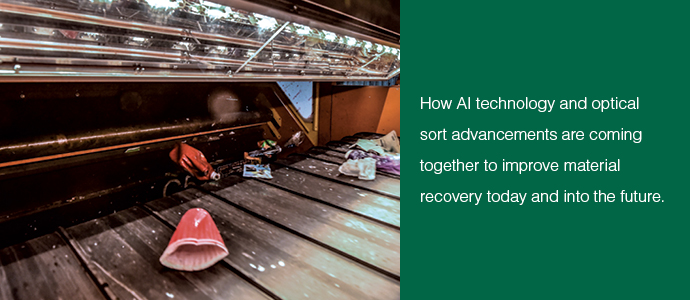
The widespread rise of optical sorters, robots and artificial intelligence throughout the waste management industry has left upper-level management with the difficult task of weighing the costs and benefits of adopting these expensive, cutting-edge technologies. Automation technology presents an unprecedented opportunity to increase productivity, accuracy and efficiency when appropriately applied.
Facilities that adopt automation technology have the potential to maximize the amount of recovered material that can be sold to end markets and push the boundaries of what can be reclaimed to include previously unrecycled materials. Additionally, these technologies can alleviate staffing issues caused by high labor turnover rates and the numerous safety concerns associated with employees working in potentially hazardous environments.
An essential feature of these technological innovations is that they are not static in their capabilities. As waste streams continue to evolve in conjunction with shifting consumption patterns across the country, automation technology can also be programmed to meet end-market requirements.
As facilities adopt automation technologies, many MRF operators seek to better understand how optical sorters, robots and artificial intelligence can better process waste streams to their plant’s advantage.
Artificial intelligence and robotics
Recent breakthroughs in artificial intelligence (AI) have garnered much attention in the media and have seen applications in a wide range of industries such as medicine, education, automobiles, waste management and more. While most people are aware of artificial intelligence, few understand how AI works.
AI systems harness the ability of computer programs to perform tasks mimicking, sometimes surpassing, human skills. These systems continually improve upon their already impressive capabilities by adhering to the principles of machine learning, a process by which computers use large and constantly evolving datasets to better anticipate and react to different inputs with more flexibility than conventional programs.
Within the context of a MRF, AI can identify many different materials passing on a conveyor belt by determining the material’s composition, form, color and other characteristics. As the AI’s program catalogs essential information about processed material, the AI system learns to make instantaneous, specific identifications of items, including the product’s brand manufacturer.
AI units can be placed at pivotal areas within a MRF to understand material capture rates, overall composition and missed recyclables. Previously, these insights could only be garnered through labor-intensive waste sorts, but they are now instantly available to facilities with AI systems. The immediate feedback provided by AI systems can assist MRF operators in making necessary adjustments to the program.
Even though using standalone AI systems remains less common in MRFs, AI technology is a necessary component of robotics systems used in the waste management industry. Robots are best suited for targeting streams that require fewer picks and are ideal for performing quality control on a commodity stream before the load is conveyed into a bunker. To maximize the robot’s potential, material streams must be prepared using either a vibratory screen, a shaker screen or surge hoppers, thus ensuring the material is adequately spaced out for the robotic grippers to collect individual items.
Robots do also have some limitations. Overly greasy material and certain packages, such as crumpled aluminum cans and plastic film, are challenging for a robot to grip adequately. Robots also require proper maintenance work and gripper replacement to stay in good working order.
Robots in action
MRFs of all sizes have invested in robots, but automated equipment is most commonly found in smaller facilities. Many smaller-sized MRFs have made significant investments in automation technology to improve capture rates and maintain a consistent source of labor. For these facilities, implementing AI-powered robots has allowed for an increase in processing capacity and profitability.
The dual-stream MRF in Emmet County, Mich. proves that robotic retrofits can benefit a rural operation. The Emmet County Recycling (ECR) MRF underwent a retrofit in 2020. This entailed redesigning the facility’s container line by adding a surge bunker and three consecutive robots, allowing for a recirculating system that operates with fewer manual sorters. Before the retrofit, the container line was nearly 30 years old and almost entirely manually sorted by staff in high-turnover positions.
“AI helped our facility better accommodate the increased volume of materials during peak months,” said Andi Tolzdorf, director of the Emmet County Department of Public Works. “Under the new AI-powered system, our facility has transitioned to a more stable, permanent workforce of fewer, higher-paid employees, including many former temporary workers who are now full-time with county staff benefits.”
Emmet County is a popular tourist and vacation home destination and experiences a large population influx during the summer. Prior to the 2020 retrofit, ECR had difficulty keeping up with the increased flow of materials during peak months. Since the installation of AI-powered robots, ECR now keeps up with processing material all year round. ECR’s improved operation begins with pre-sort staff removing problem materials – for example, garden hoses, scrap metal or batteries – off the line while a downstream magnet captures steel cans. Then, the three robots conduct the main sortation, where all like materials are individually recovered and separated into bunkers. Since all material cannot be sorted with one pass through the line, unrecovered material is deposited in a surge bunker and passed through the magnet and robots two more times.
Because of the robot’s programmability, ECR can now sort items tailored to the needs of end markets previously outside of their capacity. The system’s versatility allows ECR to pilot new material collections by designating a given bunker for a trial bale and testing the robot’s capture rates without changing operations. ECR reprogrammed the robots to target pill bottles and sleeve-wrapped PET bottles, both of which are accepted by ECR’s end markets.
Optical sorters
Optical sorters have existed longer and are more familiar to MRF operators than AI and robots. The technology behind them relies on sensors to identify materials passing along a line based on how much light a passing item absorbs and reflects. The computer processing this data directs air nozzles at the end of the conveyor to eject the material toward the appropriate conveyor. While this technology precedes the development of AI, new optical sortation programs are harnessing the power of AI to become more effective.
Optical sorters are the most efficient automation technology available to MRF operators and can target nearly 95% of properly prepared material moving at speeds of 800 to 1000 feet per minute. Newer optical sorters have improved on older models by refining the placement of air nozzles, widening the accelerator conveyor and adding an air-assist feature that prevents fiber from moving until it is ejected by the operating system. Coupled with the integration of AI and hyperspectral imaging, state-of-the-art optical sorter units can now identify and sort material by composition, form and color (including black).
Historically, optical sorters have been used to target ubiquitous and valuable materials in MRFs, such as polyethylene terephthalate (PET) containers or polypropylene (PP), a plastic that is not easily identifiable by the human eye. With the increasing integration of automation technology in MRFs, optical sorters are now more widely used to separate different grades of fiber, recover fiber from container lines and target additional containers such as high-density polyethylene (HDPE) or paper cartons.
Despite the massive strides made in developing optical sorters, challenges remain. Their success at identifying thin-walled PET bottles, items with excessive dirt, and black plastics still leaves room for improvement. Additionally, optical sorters have difficulty identifying and sorting objects that are made primarily out of one kind of material but are wrapped in another material type, as in the case of shrink-sleeve-labeled PET containers.
Rumpke’s story
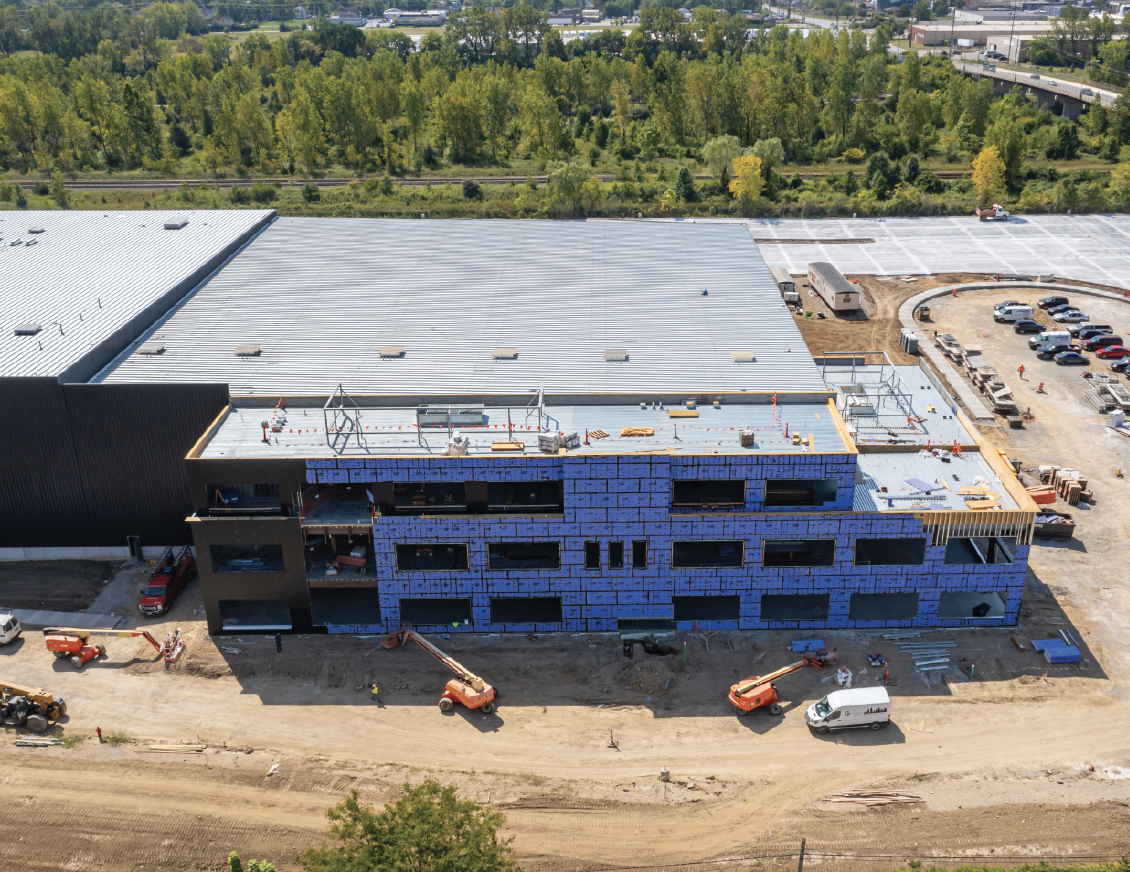
Rumpke Waste and Recycling is a family-owned business that provides waste collection services and operates MRFs and transfer stations. Rumpke has begun developing what will be one of the largest MRFs in North America, capable of processing nearly 65 tons per hour. As Rumpke’s current Columbus, Ohio facility approached the end of its useful life, Jeff Snyder, director of recycling for Rumpke Waste and Recycling, saw an opportunity to tap into the newest technologies and improvements in the sorting process.
The new Rumpke Columbus MRF, which is set to begin operations in May 2024, was designed with efficiency and a high capture rate in mind. The facility will be highly automated, including 19 optical sorter units, nine of which will be powered by AI. The inclusion of AI-powered optical sorters will allow Rumpke Columbus to autonomously sort PET into three separate categories: clear, colored and thermoforms. Optical sorters are stationed to capture fiber materials misdirected to the container line and containers that ended up on the last-chance line, pushing Rumpke Columbus toward its anticipated 97% recovery rate.
Rumpke’s ambitious goals include plans to use optical sorters to process plastic film – a notoriously difficult material which typically requires manual sortation for removal. Most optical sorter units at the Rumpke facility will be configured with suction devices to remove the film easily, send the material directly to a baler and transport it to an end market for further processing.
In addition to the AI systems working with the facility’s optical sorters, a separate, tenth AI system will be integrated into the Rumpke MRF to collect data on the waste stream’s composition. This system can be operated without running material through the entire MRF, so municipalities or neighborhoods can receive feedback on their contamination rates and commodity percentages, helping them refine targeted education programs.
“We wanted to design the facility so that as the stream continues to change, we had the ability to change with the stream,” Snyder said.
This forthcoming automated facility will possess the capabilities of managing an ever-changing material stream by using roughly eight maintenance staff working per shift, several AI-powered optical sorters harnessing the ability to sub-sort typical MRF commodities, and a surplus of bunkers for sorting yet-to-be determined commodities.
MRF designers are trending toward more automation in their facilities due to the need to tackle a changing landscape of new packaging on the market, changes in consumer behavior and labor shortages. One result is a rapidly developing market of trailblazing technologies for managing today’s waste. Another result is MRF operators pioneering these innovative solutions in versatile ways to achieve sustainable, durable facilities.
Although the focus of automation technologies is on their ability to sort waste, the impact is more significant. Their implementation creates steadier, higher-paying and safer jobs at increasingly sustainable facilities.
Holly Halliwill is a consulting engineer with RRS (Resource Recycling Systems). She can be contacted at [email protected].
This article appeared in the November 2023 issue of Resource Recycling. Subscribe today for access to all print content.