



This article appeared in the February 2022 issue of Resource Recycling. Subscribe today for access to all print content.
Once widely viewed as “unrecyclable” due to polyethylene coatings, paper cups have been a focal point of many collaborative efforts in the recycling industry. MRFs, paper mills and other stakeholders are working together to ensure viable recovery pathways and bring paper cup recycling into the mainstream.
While we know that there’s a lot of work to be done, many untapped opportunities for communities to accept and recycle paper cups exist today.
Road to recyclability
Tackling barriers to recycle paper cups requires an understanding of the volume and impacts of paper cups in the recycling system.
Beginning in 2012, the Foodservice Packaging Institute took a deep dive, learning more about MRF flows, the amount of cups and other foodservice fiber in mixed paper bales, and the prevalence of food residue in foodservice packaging. We then used that data to help MRFs and communities create sustainable, long term recovery solutions for foodservice packaging.
A central element is understanding end market realities. Paper cups are made with long, bleached fibers that are desirable to paper mills because they add strength and quality to new products made with recycled fiber. However, when we began our work, few end markets accepted paper cups.
The Foodservice Packaging Institute collaborated with several of its mill members and other industry colleagues to examine the pulpability of paper cups in mixed paper bales. Several mills have conducted trials at bench scale and mill scale and have concluded that polycoated paper cups could be effectively recovered. As a result, between 2018 and 2020, 25 mills began accepting post-consumer paper cups in mixed paper.
Another avenue for paper cups is a polycoat bale that includes cartons and paper cups. Many of the same markets that purchase carton bales also purchase bales containing cups and cartons. Including cups produces a high quality “mill spec” bale and adds volume, improving marketability. Of late, there has been increased interest in sources of recovered bleached fiber, given the limited supply of sorted office paper as COVID-19 has changed the work environment at many businesses and institutions.
In December 2021, in an unprecedented move, organizations representing 75% of mixed paper demand in the U.S. and Canada and several consumers of polycoat bales signed a declaration of acceptance and a commitment to increase the recycling of paper cups. While there are many mills in the U.S. that do not or cannot yet accept paper cups, this joint statement is a major milestone in paper cup recovery.
A broader challenge for all recycling, not just paper cups, is building or rebuilding end market infrastructure in regions like the western U.S. A focus area for the Foodservice Packaging Institute is creating domestic recovery pathways. We are engaging with emerging domestic markets and supporting mills’ testing efforts with technical information and sample materials.
Movement at MRFs and communities
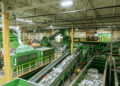
Understanding how cups flow in a MRF is vital. Based on several flow studies collaboratively commissioned by the Foodservice Packaging Institute, some fairly consistent trends emerge. In a single-stream MRF, most cups will go to the container line, even if they are flattened. Many of our MRF partners choose to capture paper cups with mixed paper and, in most cases, no additional infrastructure is needed.
Other MRFs opt to positively sort cups using manual, optical or robotic sorting. By targeting paper cups along with other items, such as cartons, they can combine these volumes into a higher-value polycoat bale.
That helps explain why in many U.S. cities, residential curbside programs are now actively accepting paper cups from millions of households. A decade ago, only a handful of communities – for instance, New York City, Seattle and Emmet County, Mich. – were recycling paper cups. These early adopters provided visible examples of success and real-world data.
To expand recycling of cups and other foodservice packaging to other cities, the Foodservice Packaging Institute launched its Community Partnership program in 2017. The program connects communities and their MRFs with end markets, technical information and communications resources.
Now, five years and 15 partnerships later, the list of U.S. cities that recycle paper cups includes Atlanta; Denver; Detroit; Louisville, Ky.; Madison, Wis.; and Washington, D.C., as well as many other communities of all sizes. Due to the Foodservice Packaging Institute’s recovery work and its partners in the state of Michigan, more than 70% of Michigan residents can now recycle paper cups. These programs have paved the way for other communities eager to grow their programs and offer their residents the ability to recycle more.
And the benefits go beyond paper cups.
The Community Partnership program focuses on adding items with best-practice outreach and an emphasis on all recyclables being clean and empty. Our partners have reported numerous benefits to quality and to program engagement overall.
Chattanooga, Tenn., for example, saw a 46% increase in the number of cart requests in its first year in the program. Louisville, Ky., launched its campaign in 2017 and realized a 12% decrease in overall contamination and 4% increase in mixed paper. Athens-Clarke County, Ga. noted a 2% decrease in residue six to nine months after its paper cup launch.
Push to hit goals
While progress over the past decade was significant, the road to reaching widespread paper cup recycling acceptance will be long.
Sustainability goals for recyclable packaging and recycled content from across the supply chain will help to facilitate progress. To meet these goals, it is necessary to continue collaboration, include cups in more programs supplying existing cup end markets, and further develop domestic end markets.
Now is a good time to take another look at paper cup recycling, and reach out to your MRF or end markets to see what opportunities may exist for your community.
Natha Dempsey is president of the Foodservice Packaging Institute and can be reached at [email protected]. Find cup recycling resources, including end market maps, communications tools and success stories at recyclepapercups.org.
This article appeared in the February 2022 issue of Resource Recycling. Subscribe today for access to all print content.