













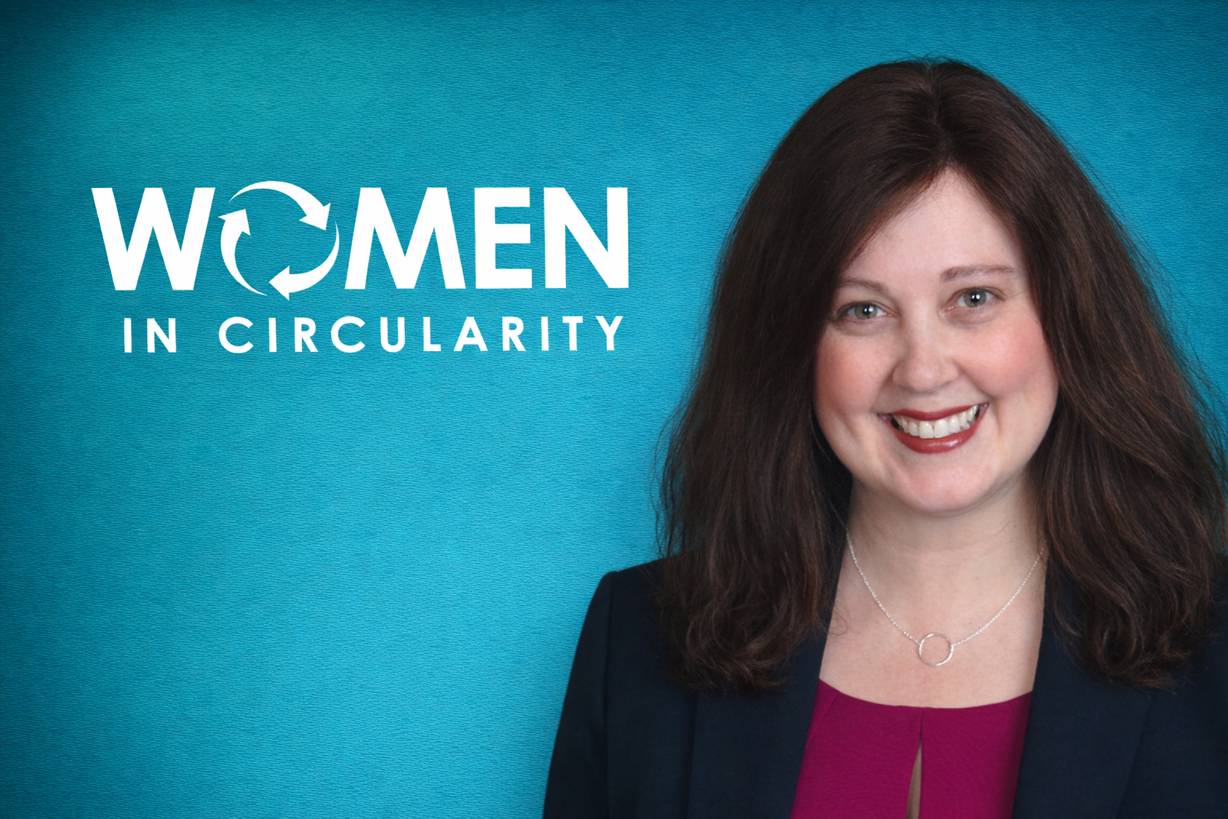
A warm welcome back to Women in Circularity. In honor of the 5th anniversary of the series, I’m thrilled to turn the tables and shine the spotlight on Women in Circularity founder, MaryEllen Etienne. As the driving force behind this dynamic platform, she’s building a movement that uplifts women’s voices and leadership in the circular economy. With over two decades of experience in reuse systems, green building and overall sustainability strategy, MaryEllen connects people, resources and opportunities to accelerate progress across the circular economy.
Your work bridges many parts of the circular economy, from reuse and recycling to green building. What sparked this career journey?
There was a lightning bolt moment for me, but it rose from energy that had been gathering for a long time. I grew up in New York as the youngest of eight children with Depression-era parents where resource conservation was simply a fact of life – nothing went to waste, and this everyday practice of resourcefulness was something I felt connected to. Still, I didn’t see it as a career path until I left a promising career in advertising to travel cross-country. While traversing 35 states, I witnessed both breathtaking natural beauty and the stark devastation of clear-cut forests and what I call the “Walmart-ification” of America. Seeing downtowns shuttered and ecosystems plundered sparked something in me: overconsumption of resources was a systems flaw and sustainable procurement and materials management could be powerful tools to reclaim value, preserve resources and strengthen communities. Somewhere along a road lined with redwood stumps I committed to pursue work that aligned with my values and focused on reshaping how we think about our finite resources.
Upon returning home, I served as an AmeriCorps VISTA volunteer with the National Recycling Coalition where I immersed myself in the waste hierarchy and gained hands-on insight into how materials move through communities. From there, I explored many facets of the reuse sector in New York City including creative reuse, building materials reuse and virtual materials exchanges. That work eventually expanded into building citywide support networks for reuse and recycling entrepreneurs in both London and New York, which later helped shape a national effort to do the same. As I grew in the field, I began connecting reuse to larger systems like green building, procurement policy and product design. If we only focus on waste, we stay at the end of the pipe. If we focus on materials and systems, we move upstream where the greatest environmental, economic and social impacts can happen. That systems lens – and the potential of the circular economy to generate real value – has guided my work ever since and continues to shape how I approach sustainability today.
What do you see as the most important skill to cultivate in circularity and how did you develop yours?
Being able to connect the dots. Circularity lives at the intersection of design, policy, economics and culture. The leaders who make the biggest impact are not just subject matter experts. They are able to forge pathways across silos. I developed this skill out of necessity. The fields of zero waste and green building both require translating between people working across the full materials chain including designers, material suppliers, service providers and policymakers. Each speaks a different language, and bridging those perspectives requires patience (you need to meet people where they are) and grit (you can’t be afraid of being told no). Over time, learning to identify shared goals and common challenges among disparate stakeholders became essential.
Curiosity can be just as important. Asking “Who else needs to be in this room?” has opened more doors than technical expertise alone. It brings in voices that might otherwise be overlooked and creates the conditions for collaboration. In a field built on interdependence, the ability to identify opportunities and connect people to the resources they need – whether that’s training, materials or like-minded individuals – is often what turns a promising concept into real systems change.
Reflecting upon the initiatives you’ve led over the years, which ones feel most meaningful to you today and why?
Women in Circularity is deeply meaningful because it is centered on amplifying the voices of leaders already leading. When we elevate women’s leadership, we expand what circular economy leadership looks like and who feels invited into it. Creating a space where women can share their expertise, connect with one another and see themselves reflected in the field has been one of the most rewarding parts of my work.
Being part of the TRUE development team was also pivotal. It helped shift the narrative from managing waste at the end of the pipe to driving upstream solutions and provided structure for organizations ready to rethink their supply chain and material management systems. Seeing companies adopt this framework – now at over 600 certified projects and counting – and prove that high-performance operations are possible, has been incredibly validating.
Likewise, past initiatives like ReuseConex, which to this day has been the only international reuse conference and expo that welcomed all facets of reuse, was remarkably impactful because it built community. Frameworks matter but movements are sustained by relationships. ReuseConex and events like Build Reuse and Minnesota’s REUSE26, which have filled its absence, are creating a platform for practitioners across sectors and geographies to meet, learn from each other and feel part of something bigger. Connecting people in this way has always been at the heart of my work and remains one of the most powerful levers for creating lasting change.
Zero Waste has come a long way since we co-developed TRUE, but more remains to be done. What do you think will drive the shift to a material-driven economy by 2040?
I would say three forces are needed: measurement, market signals and mindset. First, better measurement of material flows, not just diversion rates, along with a common language and methodology for capturing the triple bottom line impacts, will make the invisible visible. When companies track embodied carbon, material intensity and circular procurement, priorities shift and blind spots shrink. Data has a way of moving conversations from aspiration to accountability.
Second, the marketplace must reward durability, reuse and high quality recycled content. Extended producer responsibility policies, circular procurement standards and investor pressure are already nudging this transition, but scaling a material-driven economy will require stronger incentives and clearer expectations. When markets consistently value products designed to last and materials designed to circulate, business models follow.
Most importantly, mindset. We need to move from seeing materials as waste liabilities to assets with retained value, including the embodied carbon already invested in them. That mental shift unlocks innovation across design, operations and procurement. By 2040 the organizations that thrive will treat materials like inventory, not trash. They will understand the true value embedded in every product and see waste prevention and reuse as strategic advantages, not compliance tasks.
Is there a resource you recommend for those who want to deepen their engagement in circularity?
Engage with frameworks that connect theory to practice. The TRUE certification system is a strong starting point for facilities ready to put zero waste into practice and understand what high‑performance resource management looks like day to day. It shows how upstream decisions, material flow mapping and employee engagement come together in real-life operations.
I also encourage participation in communities of practice through industry conferences, peer networks and local initiatives. Circularity is relational. You learn as much from practitioners in the field as from any report because the most meaningful insights often come from people solving real challenges with real constraints.
And finally, amplify women’s voices. Representation accelerates transformation. Seek out women who are leading in policy, product design and supply chain innovation, and share their work widely. When more perspectives are visible, the field becomes stronger, more creative and more inclusive for the next generation of circular leaders.
To learn more about Women in Circularity’s 5th anniversary, read this accompanying perspective.