





This article appeared in the October 2020 issue of Resource Recycling. Subscribe today for access to all print content.
For processers of construction and demolition (C&D) materials, the key challenge is not that much different than that of any other type of recycling operation: Find an end market for the finished product.
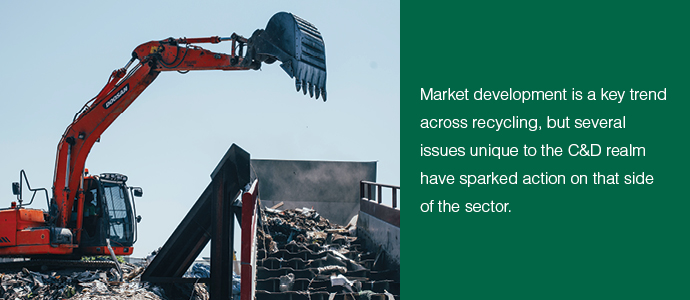
Of late, some markets specific to C&D realm have experienced shifts, spurring the recycling sector to refocus on the basic underpinnings of market development and take action to strengthen and better understand some downstream realities.
This article will lay out the recent trends and actions, some of which can help inform market development activities for other types of recyclables.
Issue identified by recyclers
In the world of C&D recycling, it is arguably simpler to collect the material and process it than to find a home for the completed product. That fact has been further complicated over the past several years.
Indeed, at its 2019 Annual C&D World Conference, the Construction & Demolition Recycling Association (CDRA) polled attendees on what were the biggest issues they wanted the association to focus on. Two dominant themes emerged: Governmental advocacy to promote the recyclers’ viewpoint, and help developing end markets.
These were interesting findings. The CDRA was already representing C&D recyclers’ interests to government officials, and had been for years. But the desire of members for end market help was new.
Based on that call from the industry’s leaders, the CDRA formed an End Markets Committee, charged to help take steps toward progress. The committee has moved forward on two fronts: conducting research to help develop new markets for problem materials and creating documents and other guidance to help recyclers.
We’ll get into the specifics of those actions later, but let’s first understand why markets have become a growing concern for the C&D side of recycling.
The move by China to clamp down on imports did affect C&D recyclers, though not quite to the degree it did for MRFs serving the residential sector. Plastics, always a challenge, are a small part of the C&D material stream. OCC is also a relatively minor part of C&D mix, though the members of the CDRA do see a fair amount of that material coming through new construction and from commercial accounts.
The main components of the C&D stream are concrete, wood, asphalt, asphalt shingles, drywall and metals.
By weight, concrete is actually the most recycled material in the United States, and most of that recovered material goes as a base product, either for roads or buildings. However, that standby downstream use has evolved over the years, and specifications have tightened. New products, such as a cement-treated base, provide a better end product. This a critical area that is impacting markets for C&D recyclers and which the industry is watching closely.
The wood portion of the C&D stream is also seeing market fluctuations.
Biomass from C&D wood is a desirable product because it is already kiln-dried and better than virgin wood, which still has a lot of moisture in it. Because of these features, for many mixed C&D recyclers, the wood fuel market has provided the financial underpinning that allowed them to tackle other products in the stream, such as drywall or carpet.
But wood fuel markets have constricted in recent years as the low price of natural gas has sparked energy producers to switch to that fuel source.
Research and guidance document
The wood portion of the stream also plays a role in some innovative market development work involving the CDRA and academia.
C&D fines – material that is less than 3 inches in size and is an unavoidable byproduct of the demolition and transportation process – have traditionally been used as alternative daily cover (ADC) at landfills.
But that use has come into question due to concerns the fines were the cause of hydrogen sulfide (H2S) gas production. Under the right circumstances (and without careful oversight by a landfill operator), H2S can be generated by the ADC product because of the gypsum from drywall that is part of C&D fines.
How to fix that problem? The CDRA is working with the University of Florida to use biochar made from C&D wood to mix in with the fines. So far, in the lab, it has been proven the biochar attenuates the H2S development, allowing the fines to be safely used in the landfill.
But not every recycling sector has a CDRA behind it trying to find end markets like this by funding research. What basic guidance from CDRA’s recent work can be applied to other parts of the recycling industry?
There are some “universal truths” to developing end markets that were recently articulated by Kathy Powles, a CDRA board member and president of asphalt shingle recycler Falcon Green Resources. The important points have been assembled into a guidance document for CDRA members.
The document, entitled “New Product Development From Construction/Demolition Debris” is all common sense and includes the following elements:
Pick a material: This may sound axiomatic, but it’s critical to remember to look at the incoming stream and see what components are relatively abundant. A market may be developed for a material, but if there is not enough incoming feed to supply the end user, it will be difficult to ensure committed use.
Learn the material’s constituents: Carefully examine what is in the material, even to the point of hiring a lab for support. Be especially mindful of any possible hazardous materials, such as asbestos. And if need be, if there is a concern about a hazardous substance in the finished product, be ready to offer to test for it in the outgoing product.
Refine incoming material: If possible, work with the generators of the incoming debris on the best way to dispose of their waste/recyclable material in order to allow for recycling. Perhaps an incentive program can be developed so the waste is provided in a preferred way.
Test, test, test: Get the environmental and engineering characteristics of the product thoroughly examined. This will be very important to back up your claims on what the product can and cannot do, as well as to show that it is not a hazardous material.
Form distribution networks: If your product is successful, think about how to sell it to a larger area.
Keep learning: Continue to participate in association meetings and meet people who have similar interests and knowledge.
These are just some of the guidelines that are contained in the CDRA document, but they should provide a direction as the entire recycling industry struggles to find new end markets.
For access to the entire document, contact the CDRA at info@cdrecycling.org.
William Turley is the founder and executive director of the Construction & Demolition Recycling Association. He can be contacted at turley@cdrecycling.org.