Resource Recycling
  • The Latest
  • Analysis
    • All
    • Certification Scorecard
    • Industry Announcements
    • Opinion
    ESG

    Foreign equity is moving into North America’s e-scrap origination

    From claims to custody: PCR procurement grows up

    Certification Scorecard — Week of August 17, 2026

    Sorted: Country roads, take my recycling

    State program revamp proposal advances in Oregon

    Oregon EPR ruling looms: what legal experts think

    Triple-digit revenue gains propel ABTC’s expansion

    LFP batteries gain acceptance. Can they be recycled?

    May pricing bullish for most bales

    August pricing bearish for plastic bales

  • Conferences
    • Resource Recycling Conference
    • Plastics Recycling Conference
    • E-Scrap: The Longevity Conference
    • Textiles Recovery Summit
  • Publications
    • E-Scrap News
    • Plastics Recycling Update
    • Policy Now
    • Resource Recycling
    • Other Topics
      • All Topics
      • Brand Owners
      • Critical Minerals
      • Glass
      • Grant Watch / RFPs
      • Markets
      • Organics
      • Packaging
      • Research
      • Technology
      • Textiles
Subscribe
No Result
View All Result
Resource Recycling
  • The Latest
  • Analysis
    • All
    • Certification Scorecard
    • Industry Announcements
    • Opinion
    ESG

    Foreign equity is moving into North America’s e-scrap origination

    From claims to custody: PCR procurement grows up

    Certification Scorecard — Week of August 17, 2026

    Sorted: Country roads, take my recycling

    State program revamp proposal advances in Oregon

    Oregon EPR ruling looms: what legal experts think

    Triple-digit revenue gains propel ABTC’s expansion

    LFP batteries gain acceptance. Can they be recycled?

    May pricing bullish for most bales

    August pricing bearish for plastic bales

  • Conferences
    • Resource Recycling Conference
    • Plastics Recycling Conference
    • E-Scrap: The Longevity Conference
    • Textiles Recovery Summit
  • Publications
    • E-Scrap News
    • Plastics Recycling Update
    • Policy Now
    • Resource Recycling
    • Other Topics
      • All Topics
      • Brand Owners
      • Critical Minerals
      • Glass
      • Grant Watch / RFPs
      • Markets
      • Organics
      • Packaging
      • Research
      • Technology
      • Textiles
Subscribe
No Result
View All Result
Resource Recycling
No Result
View All Result
Home Recycling

Recycled plastic draws focus in California

Colin StaubbyColin Staub
April 30, 2019
in Recycling

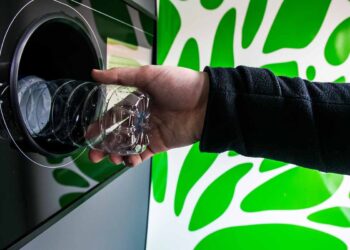
Legislation requiring 100 percent post-consumer plastic in beverage containers is gaining traction in California. Meanwhile, recently released data shows recycled plastic usage remains relatively low in the state’s bottling industry.

Under Assembly Bill 792, beverage containers would be subject to phased-in recycled plastic mandates. By 2021, beverage containers would be made of at least 25 percent post-consumer recycled plastic. That would increase to 50 percent in 2025, 75 percent in 2030 and 100 percent by 2035.

The requirement would only cover bottles included in the California Redemption Value (CRV) system and would assign a single percentage for a company that takes into account usage across the business’s entire portfolio of covered products. The CRV fee is 5 cents or 10 cents (depending on bottle size) paid by consumers but returned to them when they redeem containers.

Companies not in compliance would pay a per-container fine that would increase based on how little recycled plastic the manufacturer is using, compared with how much is required.

The bill passed out of the Assembly’s Natural Resources Committee this month and now goes to the chamber’s Committee on Appropriations. It is similar to a 2018 Senate bill that failed to pass.

Necessary or unrealistic?

A range of interests showed up to the Natural Resources Committee hearing this month and laid out cases for and against recycled content mandates, as well as the aggressive targets and time frame pushed by the legislation.

Rich Costa, director of procurement and sustainability at CarbonLite, a bottle-to-bottle PET recycling operation, supported the mandate. He said his company’s sector faces economic challenges on several fronts. Ensuring an end market for recycled PET (RPET) would go a long way to bolster the industry.

“We need ongoing guarantee from the bottling industry to secure capital investments for future growth expansions within this state,” Costa said, “and without it we could lose the greatest success story we have in California recycling.”

“Unfortunately the cost associated with recycling infrastructure in this state has no bearing on domestic or international virgin pricing, at all,” he added. “It puts our industry in a no-win situation: take orders at a loss and hope virgin resin goes up at some point, or shut down a $100 million plant.”

Mark Murray of Californians Against Waste pointed to California’s history of mandating recycled content in various products, noting the minimum recycled content required in newsprint and glass containers. Particularly in the case of glass, he said, the recycled content mandate spurred an industry that ultimately outpaced the requirements. AB 792 could have a similar effect for the PET reclamation industry, he said.

Niagara Bottling and Nestlé Waters, two of the largest bottling companies in California, both opposed the bill. Representatives from those companies pointed out that they buy substantial amounts of recycled PET in the state, but that they feel the bill is unfeasible in its current form.

The American Beverage Association (ABA) came out opposed to the bill as written, although the group voiced support for using recycled plastic. Fredericka McGee from ABA noted the collection rate is less than 100 percent, hampering complete reutilization of bottle PET from the get-go. Meanwhile, of the collected material, some is contaminated.

“You’re never going to get to a 75 percent or 100 percent rate turning around into another bottle,” she said.

Several opponents suggested lengthening the phase-in timeline or reducing the percentage requirements.

Recycled plastic usage figures

Currently, relatively few bottlers use recycled plastic in California. Out of 45 companies that reported using plastic in beverage container production last year, 13 said they used recycled resin.

The California Department of Resources Recycling and Recovery (CalRecycle) recently published its 2018 Plastic Beverage Container Virgin and Post-Consumer Resin Reports, which are required by law. The requirement applies to producers of bottles subject to the CRV.

Although the reports are legally required, the law does not specify how each company must quantify its plastic use. Some only reported a percentage of virgin and recycled content, without any weight figures. Some reported numbers without specifying the units. And other companies simply responded with, “I don’t know.”

The following companies reported their recycled plastic usage in weight. Changes from the previous year have been noted for the larger consumers.

  • Niagara Bottling: 33.2 million pounds (up from 23.7 million pounds)
  • PepsiCo: 16.4 million pounds (same weight year over year)
  • Chameleon Beverage Co.: 1.9 million pounds (up from 1.5 million pounds)
  • Maruhana USA Corporation: 4,100 pounds
  • ACN Marketing Corp.: 1,640 pounds
  • Anheuser-Busch: 136 pounds

Additionally, the following bottlers reported using a percentage of recycled content, although the weight was not listed:

  • Nestlé Waters North America: 37% (down from 42.6% in 2017, when the company also reported a recycled resin usage of 30 million pounds)
  • Danone Waters of America: 20% (up from 9.5%)
  • Dolgen California LLC: 17% (same percentage year over year)
  • Coca-Cola PET soda bottles: 9% (down from 16%)
  • CG Roxane LLC: 0.6% (up from 0%)

In addition to the above, bottlers Reeds and Aldi reported using recycled plastic but didn’t indicate whether their numbers were pounds, kilograms or other units of measure.

The largest plastic user overall in 2018 was Kroger, which consumed 103.3 million pounds of virgin plastic. The company did not report use any recycled resin.

Photo credit: Steve Heap/Shutterstock

A version of this story appeared in Plastics Recycling Update on April 24.
 

Shred Tech

Tags: CaliforniaLegislation & EnforcementPlastics
TweetShare
Colin Staub

Colin Staub

Colin Staub was a reporter and associate editor at Resource Recycling until August 2025.

Related Posts

Lawsuits hover days after SB 54 approval

NAW-backed coalition seeks SB 54 injunction

byStefanie Valentic
August 21, 2026

NAW says SB 54's 2032 recyclability mandate leans on the same standard a federal judge already froze in the SB...

The Maine state capitol building.

No bidders respond to Maine’s EPR RFP

byStefanie Valentic
August 20, 2026

Following CAA's announcement that it would not submit a bid for Maine's EPR program, the state's DEP announced that no...

The Maine state capitol in Augusta.

Circular Action Alliance won’t bid on Maine’s PRO contract

byStefanie Valentic
August 19, 2026

Circular Action Alliance announced it will not submit an RFP to implement Maine's EPR packaging program.

Landfill seen from above with equipment moving materials.

PFAS, EPR reshape waste and recycling policy

byStefanie Valentic
August 19, 2026

David Biderman, industry veteran and consultant, provided a regulatory update to attendees at WR Expo.

State program revamp proposal advances in Oregon

Oregon EPR ruling looms: what legal experts think

byStefanie Valentic
August 17, 2026

A ruling in NAW v. Feldon is expected by the end of August. Here's what legal experts think will happen.

End markets, policy key to RPET viability

PET in focus: Is help on the way?

byAntoinette Smith
August 17, 2026

California market payments progress State-level PCR mandates too new to evaluate India may provide look at future  The past few...

Load More
Next Post

Hauler struggles persist into 2019

2026 Buyers’ Guide

Equipment, services and technology suppliers serving the recycling industry.

Browse the Guide

More Posts

The Maine state capitol in Augusta.

Circular Action Alliance won’t bid on Maine’s PRO contract

August 19, 2026
The Maine state capitol building.

No bidders respond to Maine’s EPR RFP

August 20, 2026
Company debuts battery-containing device shredder

New battery shredding system debuts stateside

August 20, 2026
State program revamp proposal advances in Oregon

Oregon EPR ruling looms: what legal experts think

August 17, 2026
ESG

Foreign equity is moving into North America’s e-scrap origination

August 19, 2026
Google explores how to capture 4.5 billion tons of plastic

Bale pricing diverges for August

August 18, 2026
PureCycle sees easing headwinds to R-PP adoption

PureCycle says H2 outlook already playing out 

August 13, 2026

Sorted: Country roads, take my recycling

August 18, 2026
Triple-digit revenue gains propel ABTC’s expansion

LFP batteries gain acceptance. Can they be recycled?

August 17, 2026
End markets, policy key to RPET viability

PET in focus: Is help on the way?

August 17, 2026
Load More

About & Publications

About Us

Staff

Archive

Magazine

Work With Us

Advertise
Jobs
Contact
Terms and Privacy

Newsletter

Get the latest recycling news and analysis delivered to your inbox every week. Stay ahead on industry trends, policy updates, and insights from programs, processors, and innovators.

Subscribe

Welcome Back!

Login to your account below

Forgotten Password?

Retrieve your password

Please enter your username or email address to reset your password.

Log In

Add New Playlist

No Result
View All Result
  • The Latest
  • Analysis
  • Recycling
  • E-Scrap
  • Plastics
  • Policy Now
  • Conferences
    • E-Scrap Conference
    • Plastics Recycling Conference
    • Resource Recycling Conference
    • Textiles Recovery Summit
  • Magazine
  • About Us
  • Advertise
  • Archive
  • Jobs
  • Staff
Subscribe
This website uses cookies. By continuing to use this website you are giving consent to cookies being used. Visit our Privacy and Cookie Policy.