










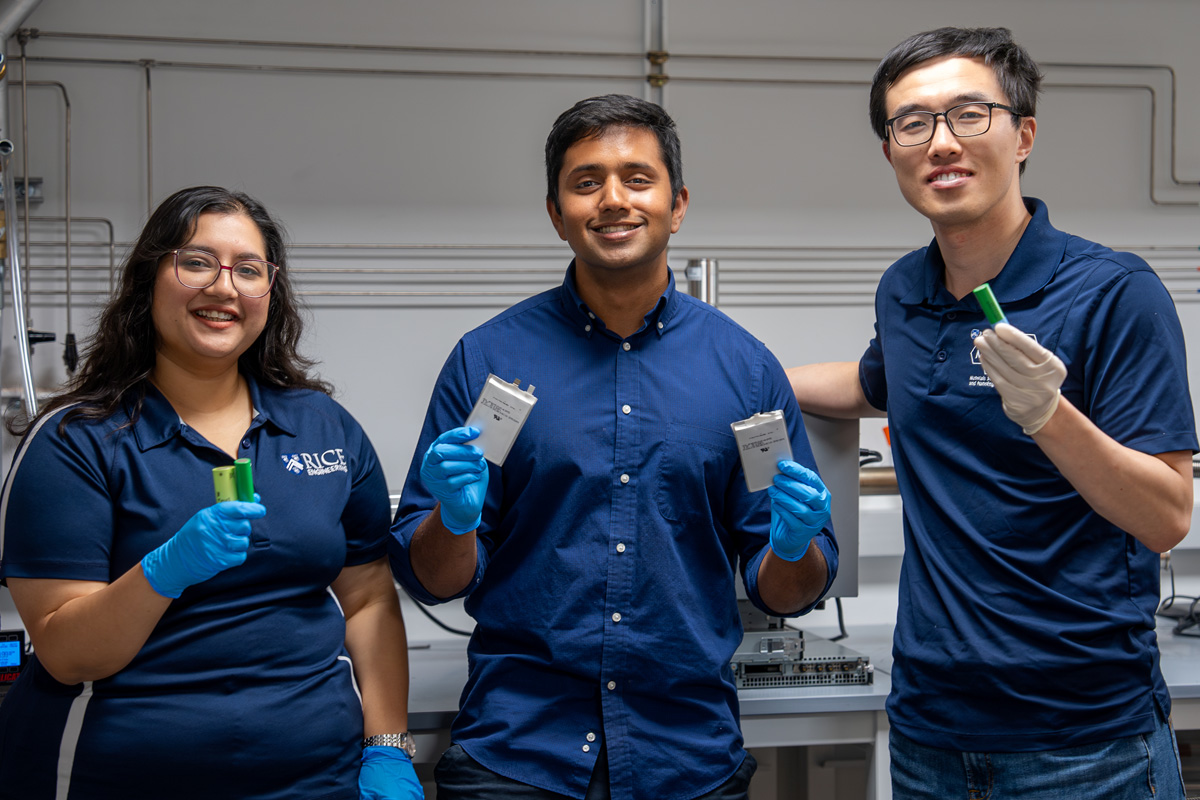
Researchers at Rice University in Texas have developed a lithium-ion battery recycling process that uses a brief plasma treatment and mild solvents to recover most of the valuable materials in black mass while also regenerating graphite for reuse in new batteries.
The method uses a 15-minute microwave-induced plasma pretreatment before hydrometallurgical recovery. In their paper, the team reported about 85% selective lithium recovery in water and about 95% recovery of transition metals in citric acid at room temperature, while also producing regenerated graphite that could be reused as an anode material.
“We have a crisis with the critical minerals required to make lithium-ion batteries, like lithium, manganese, nickel and graphite,” said Gautam Chandrasekhar, a doctoral student in materials science and nanoengineering at Rice and a first author on the study. “We were trying to develop new technologies for recycling these batteries.”
The work focuses on black mass, the shredded battery material that contains cathode metals as well as graphite from the anode and points to a possible lower-impact route for recovering minerals that remain under pressure in global supply chains.
Graphite recovery emerges as key factor
Conventional recycling routes can rely on high temperatures, strong acids or multiple processing steps and while metal recovery has drawn most of the attention, graphite often emerges too damaged for battery reuse. That matters because graphite is a major component of lithium-ion batteries by weight and, as researchers noted in a related review article, remains central to battery manufacturing even as supply and sustainability concerns intensify.
In the newly pioneered process, the plasma step changes the structure of the cathode material in ways that make downstream extraction easier in weaker solvents. Chandrasekhar said the group screened several environmentally friendly acids before settling on citric acid acquired from lemons.
“We were screening different environmentally friendly acids, and we figured out that citric acid works better,” he said.
After the metals are leached out, the remaining material consists largely of graphite, which the researchers found had been improved by the plasma treatment. According to Chandrasekhar, that result was especially striking because the team did not initially expect the recovered graphite to perform well when returned to a battery.
“What remains is graphite, which is regenerated, so we could use it again in batteries,” he said.
The group said the pretreatment could be added ahead of existing hydrometallurgical systems rather than requiring a wholly separate recycling route, a detail that could matter if the technology moves beyond the lab.
Scale-up and chemistry questions remain
Chandrasekhar said the team is already thinking about commercialization and scale-up, though he also described the current paper as an early step rather than a finished industrial solution.
“We are in the process of commercializing this technology,” he said. “There is a lot of room for improvement.”
That further work includes finding cheaper gas mixtures to generate the plasma and determining how the process performs at larger volumes. The paper reported that a hydrogen and nitrogen plasma mixture was the most effective among the gas compositions evaluated, and Chandrasekhar said cost-effective alternatives are now part of the next phase of development.
“We are looking at more cost-effective gas compositions to create the plasma,” he said.
He also cautioned against treating the results as universal across all lithium-ion battery chemistries. The black mass used in the study contained nickel manganese cobalt oxide and lithium cobalt oxide cathode materials and Chandrasekhar said the team has not yet tested the process on other widely used chemistries such as lithium iron phosphate or nickel cobalt aluminum oxide.
Even with that caveat, the work stands out for treating graphite as more than a residual material. Chandrasekhar said the remaining losses were largely tied to handling steps such as filtration rather than the creation of a separate unusable byproduct.
The research was carried out by Chandrasekhar, Sohini Bhattacharyya, Xiang Zhang and colleagues in the group of Pulickel Ajayan, Professor of Engineering at Rice. The team has patented the technology and is moving toward commercialization.