







Perhaps the ultimate white privilege is simply being able to look away.
I am a white middle-class male, brought up in a white middle-class suburb in New England. I was educated early on about the importance of the civil rights movement. I was exposed to and moved by the powerful words of Dr. Martin Luther King, Jr.
And I’ve been able to see with my own eyes the way racism continues to hold down black America: Another racially charged shooting in the news. Another statistic showing the disproportionate number of black people in U.S. prisons. Another gathering of business leaders with very few black faces in the crowd.
I also have the convenient option of putting discrimination against black people – both the shocking and subtle manifestations – into an ever-widening folder in a file cabinet in the back of my mind. These are important things that I know cannot simply be disregarded. But, ultimately, I have always been able to close the file cabinet door, leaving the actual reckoning for a later time.

Amid the current circumstances of social unrest in our country around the killing of George Floyd, I still have that option. I can learn the details, attend an event or two, make a donation, and then go back to my day-to-day world of relative safety and comfort.
I suspect that many readers of this publication can relate. Many of us who are decision-makers at recycling companies and within community recycling programs come from the same fold of white society that I do. We are troubled by the deep racial problems embedded within our country’s past and present, and we do want to play a role in change for the better.

But the issue seems so large, so complex and so fraught with emotion that the natural course of action is to pay respect and then slowly step away – usually in silence, for we never want to say the wrong thing.
A chorus of varied voices
For the country’s black population, of course, the choice of distancing oneself does not exist. The George Floyd killing is just the latest episode illustrating how black individuals are always a step away from violence, many times at the hands of the police officers we pay to protect us.
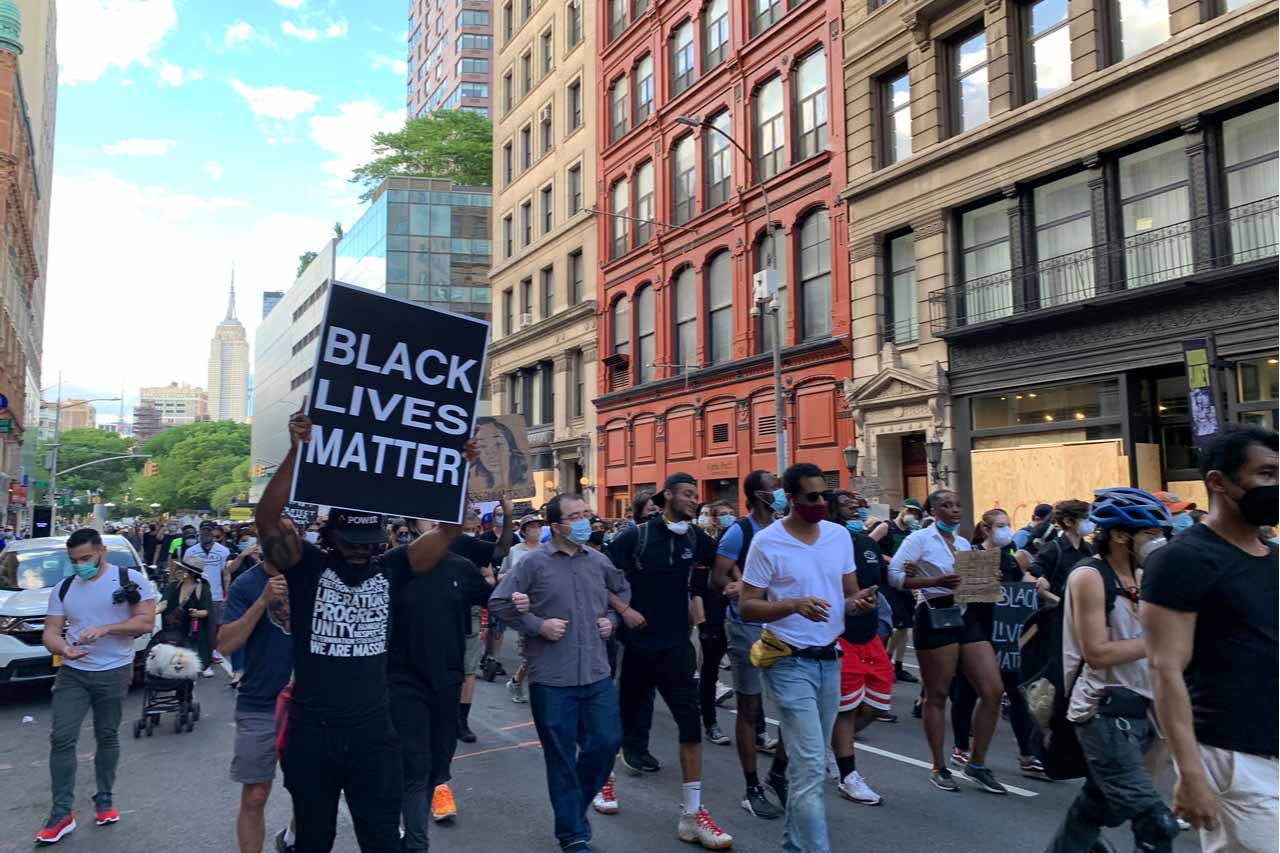
Over the last two weeks, the black cries against injustice have been joined by voices from the rest of society in a way not seen in decades.
“It is clearly a rainbow that is outraged at what is happening in the United States,” U.S. Rep. Karen Bass, D-Calif., said on NPR’s “Morning Edition” this week. Bass, chair of the Congressional Black Caucus, is trying to harness this coast-to-coast energy to advance new legislation to reshape American police departments.
Such action on a national level is heartening, and the mere prospect of significant policing reforms in relation to race could not have happened without vocalized support of Black Lives Matter and other pieces of the movement from a wide spectrum of individuals, groups and companies, including many in the recycling sector.
But one eruption of outrage, even if accompanied by major legislation, is not sufficient. The civil rights movement of the 1960s brought with it unprecedented conversation and lawmaking, yet here we are half a century later, continuing to see the death and community devastation that is the toll of institutional racism.
“The challenge here is to sustain the current sentiment and not let this version of Freedom Summer be yet another moment when allies fail,” New York Times columnist Charles M. Blow wrote this weekend.
Understanding our levels of influence
How do we as a recycling industry help ensure the current momentum for justice continues far into the future? One key is to realize and activate the power we all have in our individual roles.
First, we can make shifts in that realm where we hold the most influence – the realm of ourselves.
To help actually undo racist holds on society, we need to know where and how that is happening. A remarkable assortment of articles, books, documentaries, podcasts, lectures and more is available to help us educate ourselves on the topic.
The importance of that step should be particularly clear to leaders in our industry. Community staffs work hard to educate residents of local recycling program realities so that those individuals will “do the right thing.” The same holds true for racial justice. You can’t move forward without getting expert perspectives on the why and how of meaningful action.
The next level of influence we have is within our own teams. Recycling entities tend to be close-knit groups of people drawn to their work because they want to make a difference in the world. There is now an opportunity to gather together in real conversation about how your operation can make an impact.
You are not on your own to do this. Many cities and some companies already have equity and diversity departments that were established to help drive this type of work – and to point out areas for improvement.
The Equity Office for the city of Austin, Texas, for instance, recently reported that city departments were struggling to collect race and ethnicity data related to who was being selected for city contracts and who was receiving outreach and engagement within the community. Without such quantification, “it is difficult for the city to assess the impact or lack of impact it is having on communities of color and other marginalized populations,” a report from the Office of Equity noted.
Now is the time to nourish those networks, and to listen to their perspectives on ways to engage and improve. If such a program does not exist in your office, this is an ideal moment to launch one.
Finally, there is the fact that recycling entities are out on America’s streets every day. Our industry has experience working with diverse populations to solve waste issues, and our employees inevitably see the realities of injustice as they move through collection routes and undertake communication with residents.
As communities respond to growing calls to improve the treatment of black citizens by their police forces and across government, how can waste and recycling divisions use their experiences to help guide wider progress? And how can waste and recycling officials learn from the reforms that will inevitably be taking place in other departments?
Answering those questions will require officials to take an open and honest look at some harsh racial realities that are tied to the waste and recycling sector.
For instance, in many communities, waste facilities are sited closer to the homes of minority populations than to the neighborhoods of whites. A 2007 study from the United Church of Christ Justice and Witness Ministries found people of color make up the majority of residents living within 1.8 miles of America’s hazardous waste facilities. A 2016 study from University of Michigan researchers looked at over 30 years worth of data and found a troubling pattern of cities targeting minority neighborhoods when building hazardous waste operations.
It is this type of geographic disparity – in waste and recycling, as well as in other industrial sectors – that has contributed to the fact that minority populations in this country bear the brunt of industrial pollution. Research from the University of Minnesota and the National Science Foundation has found people of color in the U.S. are on average exposed to 38% more nitrogen dioxide than whites (nitrogen dioxide is a widespread air pollutant formed when fossil fuels are burned).
‘In every area of American life’
Confronting such realities is hard work, and it’s extra work. For many of us, the option to just close the mental filing cabinet will remain, especially once another crisis grabs our collective attention.
But simply moving on is unacceptable.
At George Floyd’s memorial service in Minneapolis last week, the eulogy was given by Rev. Al Sharpton. He made clear how the fight for racial justice is more than just transforming one police department or passing bills. It’s a movement that involves every segment of society.
“What happened to Floyd happens every day in this country, in education, in health services, and in every area of American life,” Sharpton said. “It’s time for us to stand up in George’s name and say, ‘Get your knee off our necks.'”
This is the time to look clearly at the black discrimination that is inherent in American life, and to take action in whatever way we can, starting with ourselves and moving outward through our companies and communities.
This needs to happen today, tomorrow, and again and again.
The opinions outlined in this article are the views of the author and do not necessarily represent Resource Recycling, Inc.
Dan Leif is the managing editor of Resource Recycling and can be contacted at [email protected].