






Minnesotans still have time to weigh in on the state’s extended producer responsibility (EPR) law before legislators finalize the details.
A preliminary assessment required by the state’s Packaging Waste and Cost Reduction Act is open for public comment through Dec. 22. The law passed in 2024 and requires packaging and paper product makers to reduce the environmental impacts of what they manufacture while managing them throughout their life cycles.
The assessment was done by Eunomia Research & Consulting on behalf of the Minnesota Pollution Control Agency (MPCA) as required by the law. It will be followed by a needs assessment next year.
“The preliminary assessment is being used as a tool to start the process of data collection on recycling and composting of materials covered in this law,” said Mallory Anderson, packaging EPR coordinator for the MPCA. “It allows the agency a ‘checkpoint’ on what information is collected in the state to inform this work and identify gaps that will need to be investigated as part of the needs assessment.”
The assessment found several potential areas for improvement. At least some cities in three of the state’s six regions had no recycling collection or drop-off options, with curbside recycling topping the 50% availability threshold only in Minnesota’s Twin Cities metro area. The report found about 75% of residents in that region as well as the state’s north-central and southeast regions were served by curbside recycling, while more than 90% of the cities in the state’s northeast region could only use drop-off sites.
As for organics collection, more than half of all cities outside the Twin Cities had no collection service available for organic waste. More than half of the state’s residents are covered, however, since 56% of residents live in the Minneapolis-St. Paul area.
“We expect to see more robust collection options for these materials and more reuse, recycling and composting of packaging and paper covered under the law,” Anderson said. “We also expect to see more education and outreach on how to reduce, reuse, recycle and compost packaging and paper.”
Circular Action Alliance (CAA) will serve as the producer responsibility organization in Minnesota, as it does in six other states; Anderson said producers had to join CAA by this past July. CAA will collect producer fees after a stewardship plan is in place and run a program to ensure compliance with the law. The stewardship plan is due by October 2028.
“The [state] Legislature based this law on previous packaging EPR laws and the lessons learned from implementing them, including the need for additional time during implementation,” Anderson said.
From there, producers will gradually see their share of program expenses grow from 50% of net recycling costs in 2029 to 90% in 2031. The report found the estimated statewide curbside recycling service cost in 2024 to be $113.7 million, while residential organics collection services cost $50.4 million; no data were available for commercial or drop-off recycling.
In addition to paying for collection and processing costs, producers will have to contribute money toward material management infrastructure improvements the MPCA deems necessary.
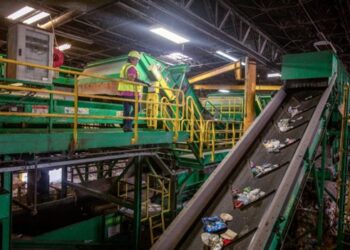
As one potential example, the report found parts of the state have no MRF within 100 miles. For another, it found many facilities outside the Twin Cities rely more upon manual sorting of materials as opposed to higher-tech options.
Almost half of the state’s annual 6.3 million tons of waste is recycled or composted, which Anderson said allows for improvement.
“Minnesotans already do better at recycling and composting than neighboring states, so it’s important that our extended producer responsibility program builds on that instead of merely creating efficiencies or changing who is covering the cost of that waste,” she said. “Rather, we want provisions in a program that expand our waste prevention, reuse and recycling programs, which ultimately provide us with more desirable results.”
The needs assessment resulting from this preliminary report will include the official baseline for program measures and outcomes, recommendations on where to make investments, recommended reimbursement rates for service providers and outreach/assessment suggestions. The law requires a new one every five years. Before that, an advisory board assigned to this program will meet twice in December.