



This article originally appeared in the November 2017 issue of Resource Recycling. Subscribe today for access to all print content.
Recycling infrastructure has always been a piece by piece endeavor, with municipalities, states, private companies, regional bodies, nonprofit groups and other actors all potentially involved in handling the same stream of material.
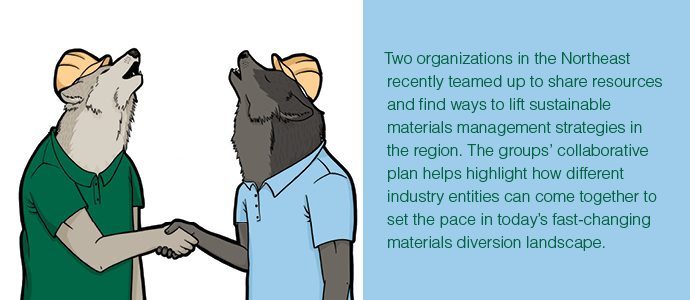
It’s not surprising then that as the waste diversion ecosystem goes through its inevitable shifts and reformulations, the management structure can get a little jumbled. At times it may seem there are too many perspectives on an issue. At others, topics of growing importance may be handled by a lone wolf when a full pack is really what’s needed. In the Northeast U.S., two organizations have recently taken action to proactively engage on issues to help recycling systems in the region thrive now and into the future. The process by which the groups have worked together can help guide other recycling entities looking to develop working relationships in the midst of larger change.
Additionally, the groups’ shared roadmap offers a rundown of topics – such as organics innovation and the relationship between waste management and climate resiliency – that are likely to be of growing importance for the recycling industry as a whole.
Two groups, one region
The Northeast Recycling Council (NERC) and Northeast Waste Management Officials’ Organization (NEWMOA) are regional nonprofit groups that are both around 30 years old.
NEWMOA and NERC operate in similar geographic areas (see map below) and involve many of the same state agencies. Both organizations help state programs and others in the Northeast, as well as nationally, to develop and implement sustainable materials management and pollution prevention strategies, including source reduction, reuse, diversion of organics for composting or anaerobic digestion (AD), recycling, environmentally preferable purchasing, toxics in products, and toxicity reduction in the solid waste stream. Both organizations also focus on supporting implementation of product stewardship programs.
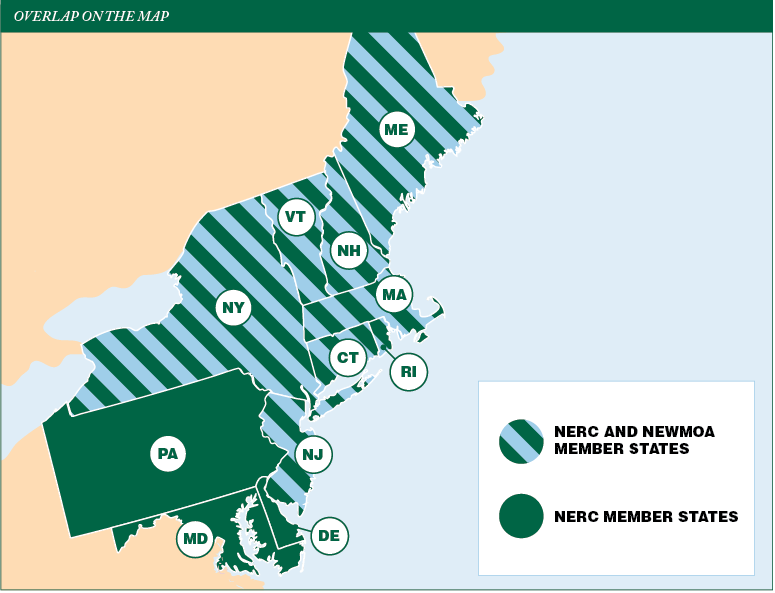
At the same time, significant differences exist between the groups when it comes to the specifics on geographic area, board membership and membership base. NERC serves a slightly larger geographic area and includes private sector members within its governing board. NEWMOA’s board, on the other hand, includes the directors of the members’ states waste and pollution prevention programs.
Differences also exist in areas of focus. NEWMOA’s work includes industrial and commercial hazardous waste management, brownfields and contaminated site cleanup in addition to the topics outlined above. NERC has a focus on enhancing capacity within the recycling industry and downstream markets.
Further, while NERC generally focuses on supporting voluntary programs, NEWMOA supports state implementation of waste policies and laws and regulatory and enforcement programs as well as voluntary programs.
Finally, NEWMOA facilitates interaction and communication between state environmental agencies and the U.S. EPA. NERC, meanwhile, facilitates public-private partnerships and engagement.
Worth having separate groups?
For most of the time the groups have been active, their priorities were clearly distinct, but in the past 10 or so years, these areas of activity have increasingly overlapped, which caused their respective boards to begin questioning how they actually differ and whether it’s worth it to support both. These are important, if uncomfortable, questions.
In an effort to address these concerns, the organizations’ respective executive directors (who are the authors of this article) engaged in a series of conversations in 2013 and 2014 that resulted in a memorandum of agreement that stated their shared interest in trying to leverage each other’s expertise and experience to benefit the health and environmental quality of the region by ensuring that the organizations do not undertake similar projects without first establishing a clear distinction between such efforts.
The memorandum also incorporated several key principles for effectively moving forward together. First, it encouraged collaboration on initiatives and projects where both organizations have an interest. Examples of such teamwork include cross-promotion of events, searching for joint funding for new initiatives and sharing reports and other information.
While this memorandum drafting effort led to enhanced communication and cooperation, the executive directors of each group felt that they could take the collaboration to another level. As such, in late 2015, they proposed to their boards that the organizations develop and commit to a joint strategic plan.
This was endorsed, and for the next 12 months the executive directors developed a document that clearly articulated the differences between the organizations and the distinct value of each. The process also served to chart a course for collaborative action to further their missions. The resulting five-year plan was successfully adopted by both organizations in early June 2017 and implementation has begun.
Five areas of shared focus
The strategic plan focuses on five priority areas of mutual concern. These include food waste reduction and recovery; recyclables collection and downstream impacts; product stewardship; industry touchpoints with climate change; and construction and demolition (C&D) materials.
Within each priority area, short-term and long-term activities have been identified. Most of the short-term activities are anticipated to be achievable within the existing budgets and staffing of the organizations. And since adoption and publication of the plan, the executive directors have put together a schedule for implementing the short-term action items within the next 12 months, with many being completed before the end of calendar year 2017.
Among the items anticipated to be addressed in the short term are the following:
- Cataloguing funding opportunities for generators and developers of food de-packaging technologies/facilities as well as anaerobic digestion (AD) and composting facilities.
- Regional information sharing on emerging technologies to enhance material processing at MRFs.
- Coordinating on various topical workgroups.
- Regional information sharing and networking with forward-thinking state programs around the country.
- Convening a meeting of state product stewardship councils.
- Identifying waste facilities that are particularly vulnerable to sea level rise and extreme weather events.
- Creating a web page for use on both organizations’ websites that has links to existing resources for C&D debris management.
Stakeholders who are key to advancing waste recovery systems have come forward to applaud and support these goals.
For instance, Robert Klee, commissioner of the Connecticut Department of Energy and Environmental Protection (DEEP), noted that “these nationally recognized interstate organizations have a proven record of success with projects that support and advance our work efforts here in Connecticut. Working together to implement the joint NERC and NEWMOA strategic plan is closely aligned with the mission of DEEP and our goal of doubling the recycling rate in Connecticut to 60 percent.”
Peter Pettit, director of the Bureau of Waste Reduction & Recycling within the New York Department of Environmental Conservation, noted similar sentiments. “This partnership will help support the activities of these two great organizations,” he said, “and benefit our members as we address common environmental challenges and develop joint solutions.”
Looking out over long term
In the longer term, the organizations have an ambitious agenda that includes seeking funding for a number of areas, notably food waste, improvement of recycling streams, product stewardship, and climate resiliency and climate change mitigation.
On the food front, the goals are multifaceted. The groups are focused on developing and implementing technical assistance and education programs to assist large consumers of food to reduce waste, divert unwanted food to food banks and ship their remaining food waste to compost or AD facilities. The partners also aim to adopt consistent language, symbols and coloring across the region for food scrap collection at large generators and for curbside residential collection.
Further, they have the objective of identifying and publicizing best practices for de-packaging packaged foods, helping state programs update and implement composting regulations and capacities, publicizing best management practices for managing residuals from AD operations and convening a wide range of state agency officials to develop strategies for diverting food waste to higher uses and for increasing use of compost and residuals from AD operations.
Other food scrap plans include identifying and promoting markets for finished compost and researching possible emerging contaminants and invasive species that could impact the uses of food waste, composted materials and AD residuals.
When it comes to improving the recycling stream, NERC and NEWMOA would like to facilitate a regional dialogue to achieve agreement among MRFs, states and communities on a set of materials that will be universally accepted as part of municipal recycling programs.
In addition, they are aiming to research and promote strategies to support recycling markets for specific materials, such as glass.
On product stewardship, strategies include exploring opportunities for states to coordinate and harmonize their product stewardship programs, creating a forum for sharing information on the successes and challenges of stewardship programs in the region, and identifying opportunities and challenges for regional product stewardship initiatives.
Finally, there is the increasingly pressing realm of climate resiliency as global warming continues to make a tangible impact on modern life. NERC and NEWMOA aim to identify needs for resiliency planning for high risk sites and research available resiliency strategies that waste facilities can adopt. From there, the plan is to work with facilities to implement resiliency measures.
Additional steps in this realm include helping state programs to increase the capacity for the proper processing, reuse and recycling of MSW, C&D materials and other disaster debris wastes; creating information resources and tools that demonstrate the relationship between materials, materials management and climate change mitigation; and identifying goals for greenhouse gas emission reductions in the region resulting from sustainable materials management programs in order to support and enhance the achievement of regional greenhouse gas reduction goals.
Such efforts will help create a template for state and local action for materials management strategies as a tool in climate change mitigation and facilitate collaboration among states and stakeholders on implementation.
Excitement despite obstacles
Of course, putting together a plan is one thing, but effectively putting it into action is another. For instance, one final step that has yet to be completed is developing measures for evaluating progress toward addressing the issues and topics identified in the plan. And there is the ongoing funding question. Though short-term efforts can be covered by existing budgets, there is no easy answer to the question of where money will come from for the more future-focused initiatives. Collaborating on securing such funding will be an important part of successfully implementing the plan.
Nonetheless, the boards of both NERC and NEWMOA are excited by this venture and the anticipated results and benefits. It marks a watershed moment in sustainable materials management in the region. And it could help chart directions forward for program leaders around the country.
Lynn Rubinstein is executive director of the Northeast Recycling Council, Inc. and can be contacted at [email protected] or 802-254-3636. Terri Goldberg is executive director of the Northeast Waste Management Officials Association (NEWMOA) and can be contacted at [email protected] or 617-367-8558 x302.