




This story originally appeared in the January 2016 issue of Resource Recycling.
Subscribe today for access to all print content.
By now, recycling professionals are well aware of the Green Fence, the customs crackdown implemented in 2013 to reject loads of dirty scrap coming into China. But while the industry has begun to adjust to those import regulations, the nuances of China and recycling extend beyond bale specs.
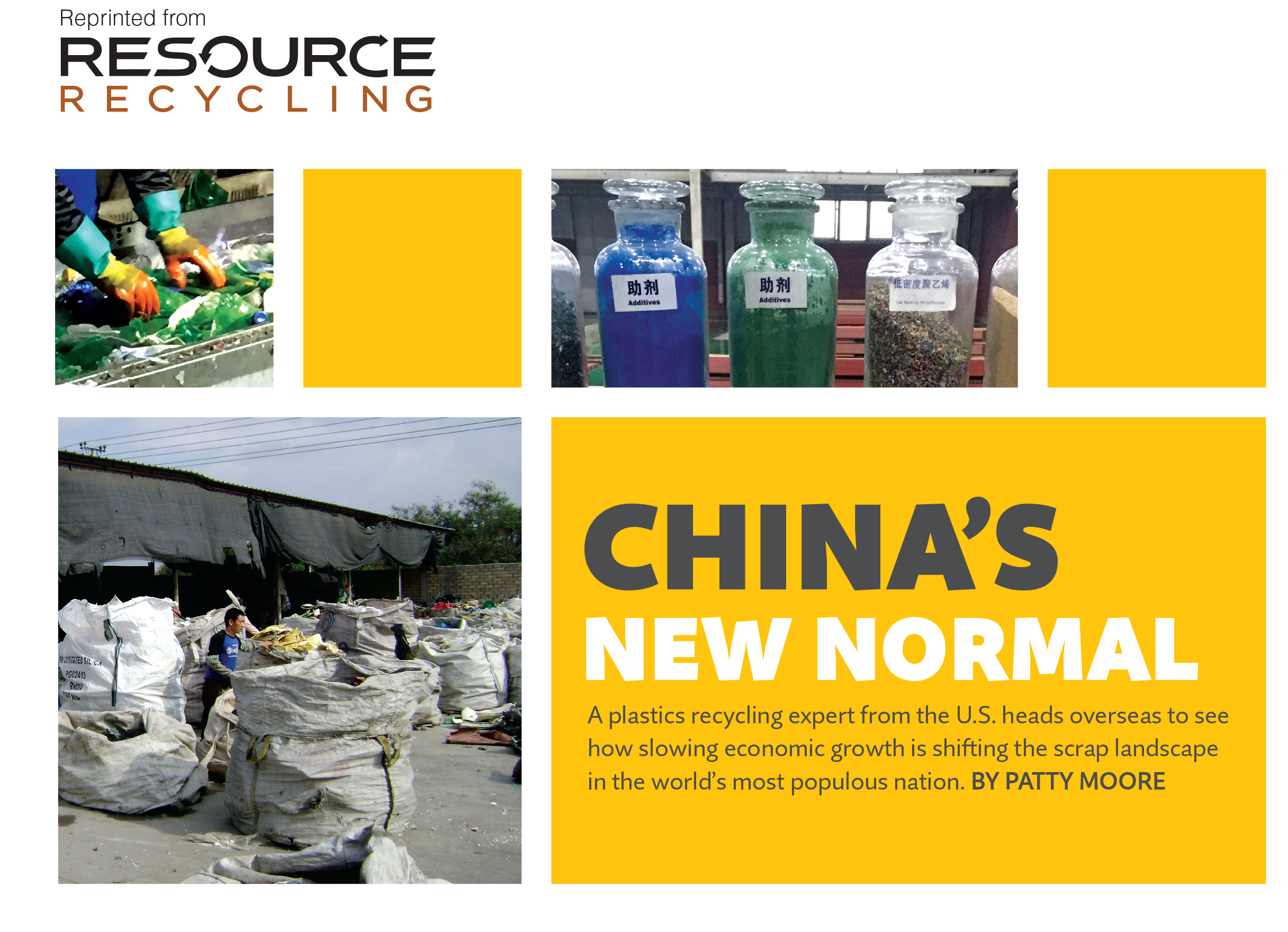
A recent trip to the Mainland opened this writer’s eyes to the state of Chinese economics as a whole. China’s decades-long period of frenzied growth in manufacturing is tapering off, and it’s searching to find an economic engine for the future. What do North American recycling representatives need to know as the Asian giant transitions?
Back when demand was expanding
My first trip to China was in 1996 as part of a U.S. Commerce Department trade mission that centered on plastic. I was the only delegate that was focused on recycling, but I was certainly not the only one interested. At the meetings set up for the event, there were long lines from buyers that wanted to meet with me about purchasing supplies of U.S. plastic scrap; the demand for recycled plastic in China was strong and expanding. Shipping scrap plastic to China made economic sense because China was a huge and growing manufacturer of goods that needed low-cost raw materials.
China’s plastic reclaimers were – and are – able to convert almost all of the properly prepared scrap plastic we send them, using it as lower-cost raw material for their use in manufacturing new products. But in 1996, and for many years later, they did not have the infrastructure to properly handle contamination and waste water. This lack of waste management infrastructure was recognized by the Chinese government, and that year the government banned the importation of unprocessed post-consumer plastic scrap. Yet scrap imports continued nearly unimpeded, the volume growing every year.

In 2007, China established technical specifications for pollution control during the collection and recycling of plastic waste, which set regulations for air, water, noise and waste pollution. Yet another law was passed in 2009, and that one went further in trying to regulate the industry, requiring the registration of foreign suppliers and domestic assignees. The measure also established on-site inspections before loading at the port of origin and the training of over 1,880 new General Administration of Quality Supervision, Inspection and Quarantine (AQSIQ) staff members to provide unified law enforcement, which ultimately led to the Green Fence effort in 2013.
In 2011, I published a report after traveling to China – it can be viewed at tinyurl.com/Moore2011Report. In it, I noted: “Strong demand and lack of inspection at our end coupled with the cavalier attitude of many suppliers causes problems. This part of the system is broken and needs to modernize. Whether this modernization comes by acts of free will or is legislated, the eventual placement of safeguards is necessary and inevitable.”
We have now felt those safeguards imposed by the Chinese government, beginning with the Green Fence effort and continuing today.
The present climate
This past November, I visited China to learn more about an announced import enforcement action. What I learned was that plastic recyclers in China have much bigger things to worry about than such regulations. For the first time, supply exceeds demand. Factories and warehouses are constrained because of the slowing economy. One speaker during the China Scrap Plastics Associations’s (CSPA) ChinaReplas noted that the very rapid development of the past 30 years is over.
In 1979, China was very poor, and people wanted to find a way to buy products like bicycles and TVs. Production of those items drove the economy. By the end of the millennia, many Chinese citizens were able to afford these items and there was a boom in the property market – including demand for household items – along with strong global demand for Chinese goods. Today, China has lost the driving forces of the export and property markets, and domestic development is slower. China is transforming from production and consumption to sustainable development. This is the new normal.
Another change is the path taken by much of the U.S. scrap plastic imported into China. Formerly, transloading from overseas containers to regional containers would occur in Hong Kong, and then those containers were sent to plastics recycling warehouses for purchase by small regional reclaimers. Government regulations and the economy are shutting down small recyclers and warehouses in favor of direct ship to larger government-regulated facilities.
As noted in a CSPA newsletter earlier this year, scrap plastic traders are also feeling the pinch. Better access to suppliers, primarily due to the Internet, is narrowing the margins in trading. Easy access to intelligence is making the market more transparent, and according to the CSPA, this dynamic is “forcing the mode of operation to change. It has become easier for end-user factories to access upstream suppliers overseas and vice versa.” Some scrap traders question if there is a future for the business they’ve been in for decades.
Like those who operate in other businesses in China, successful plastic recyclers are adapting to the new economy. The plastic recycling industry is shifting from imports to internal collection, as well as from small factories to larger, more efficient factories with better quality. This change means more capital investment and a shift to vertical integration. Plastic recyclers in China are moving to base their output on specific customer needs and are moving from lower-value products to higher-end products.
During my 1996 visit, I only saw one plastics recycling facility – it was a side trip I made to see the then-largest PET recycler in the country. While the sorting and washing equipment at the facility was primitive – largely by hand – the grinding and pelletizing equipment was relatively modern. The end product fed the polyester fiber industry, as did essentially all PET reclamation facilities in China, then and now. However, similar to what is happening in the U.S., the PET recycling industry in China is expanding its markets from fiber only to include high-value end products, including bottles and packaging.
What lies ahead
According to Washington, D.C.-based think tank Center for Strategic and International Studies, Chinese leadership is struggling to manage a difficult transition to its new normal of slower and more sustainable economic growth. The infrastructure projects proposed as part of the economic development effort, referred to as “Belt and Road,” may provide stimulus to help cushion the effects of this deepening slowdown. By improving connectivity between the less developed southern and western provinces, the wealthier coast, and bordering countries, Belt and Road may spur more regionally balanced growth. Moreover, the construction is intended to help make use of China’s enormous industrial overcapacity and to ease the entry of Chinese goods into regional markets. Chinese plastic recycling businesses are looking to Belt and Road with hope.
According to a ChinaReplas presentation by a representative of China’s Ministry of Environmental Protection, there is still a need for stricter regulation on the management of material. While he did not provide many details, the representative noted that in 2016, import control will occur at the port of export and import licenses will be eliminated. He also noted China Commodity Inspection Corporation (CCIC) and customs will be working as a single organization to ensure that all the enterprises importing are doing things properly and to see if “they learned the lessons” of the past two years.
Meanwhile, economic experts in China wonder how plastics recycling facilities can continue the transformations needed if half of their energy is focused on business and the other half on dealing with the government. In fact, some business people I spoke with in China told me it seemed that plastics recycling operations actually have more like 70 percent of their energy focused on the government.
With the new normal taking hold, Chinese reclaimers have more in common with their U.S. counterparts than ever before. Demand has weakened, virgin pricing is low and margins are squeezed. And the commonality also applies to quality: Now, more than ever, reclaimers need high-yield material with low contamination. This means that U.S. plastic scrap suppliers, which are also under pressure to improve their financial returns, must sustain the quality of their material to meet China’s market demand.
U.S. suppliers can no longer create material for the export market that is of lower quality than material going to domestic buyers. The North American and Chinese plastic recycling industries – from suppliers to reclaimers to product manufacturers – are under pressure to embrace the new normal by meeting customer needs, improving efficiencies and increasing quality.
Patty Moore is president of Moore Recycling Associates, Inc., a consulting and business management firm established in 1989. Moore began working in the recycling industry in 1983. She can be contacted at [email protected].