





Advertisement Header Ad
Resource Recycling
  • The Latest
  • Analysis
    • All
    • Certification Scorecard
    • Industry Announcements
    • Opinion

    Certification scorecard for Dec. 18, 2025

    Industry announcements for the week of Dec. 15

    Certification scorecard for December 10, 2025

    Industry Announcements for Week of December 8

    Certification Scorecard for December 3, 2025

    Industry Announcements for Week of December 1

    News from Dynamic Lifecycle Innovations, Precision E-Cycle

    News from Northeast Recycling Council, Plastipak and more

    News from Northeast Recycling Council, Sortera Technologies and more

  • Conferences
  • Publications

    Other Topics

    Textiles
    Organics
    Packaging
    Glass
    Brand Owners

    Metals
    Technology
    Research
    Markets
    Grant Watch

    All Topics

Subscribe
No Result
View All Result
Resource Recycling
  • The Latest
  • Analysis
    • All
    • Certification Scorecard
    • Industry Announcements
    • Opinion

    Certification scorecard for Dec. 18, 2025

    Industry announcements for the week of Dec. 15

    Certification scorecard for December 10, 2025

    Industry Announcements for Week of December 8

    Certification Scorecard for December 3, 2025

    Industry Announcements for Week of December 1

    News from Dynamic Lifecycle Innovations, Precision E-Cycle

    News from Northeast Recycling Council, Plastipak and more

    News from Northeast Recycling Council, Sortera Technologies and more

  • Conferences
  • Publications

    Other Topics

    Textiles
    Organics
    Packaging
    Glass
    Brand Owners

    Metals
    Technology
    Research
    Markets
    Grant Watch

    All Topics

Subscribe
No Result
View All Result
Resource Recycling
No Result
View All Result
Home Plastics

Building programs with racial and social equity

Marissa HeffernanbyMarissa Heffernan
August 22, 2023
in Plastics
Share on XLinkedin

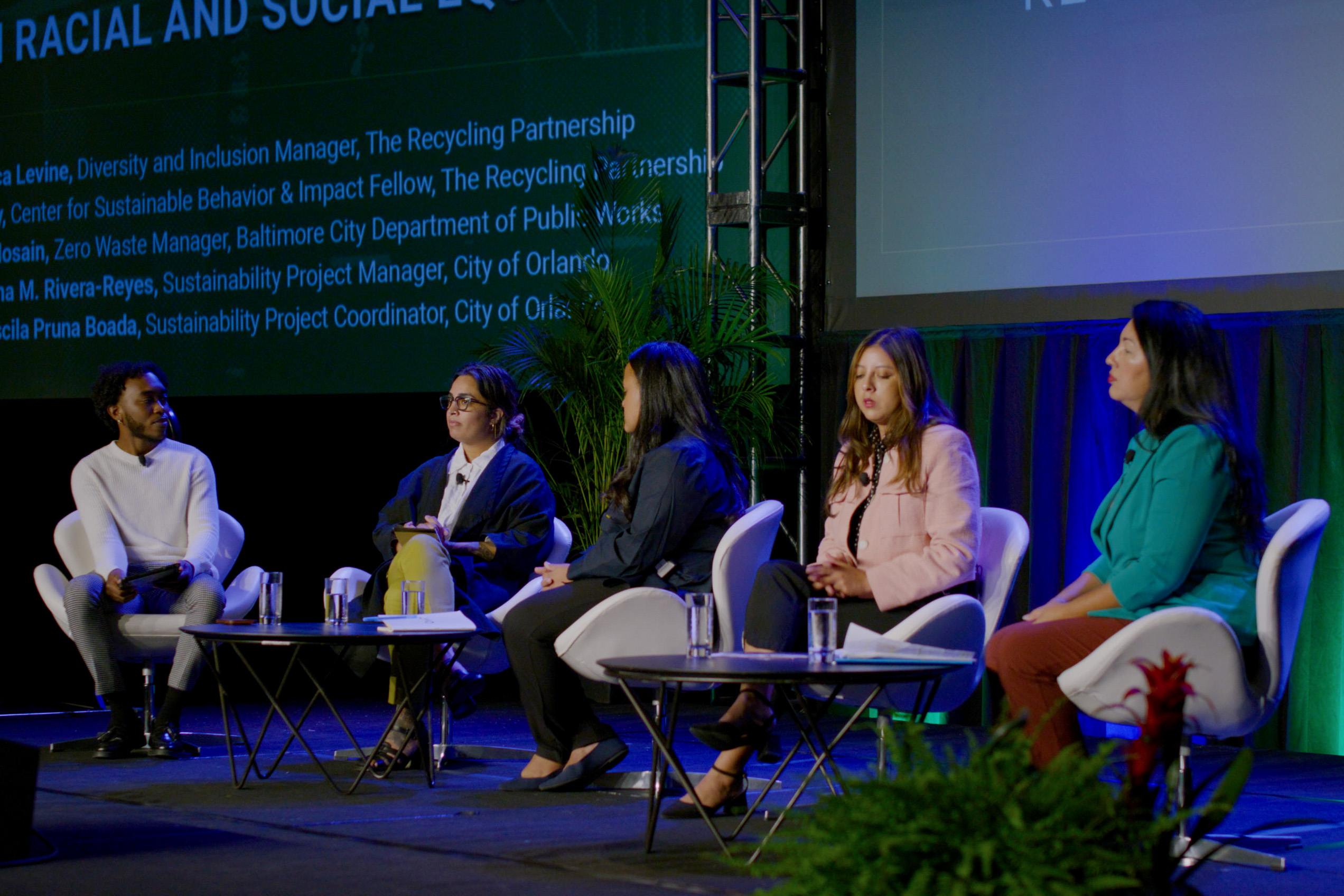
Moderator Kevin Goolsby of The Recycling Partnership speaks with panelists (L-R) Sophia Hosain of Baltimore Public Works, Jessica Levine of The Recycling Partnership, Priscilla Pruna Boada of the city of Orlando, and Digna Rivera-Reyes of the city of Orlando. | Big Wave Productions/Resource Recycling, Inc.

An inclusive and equitable recycling program is a complicated but necessary undertaking. Industry experts recently offered tips on how to get there.

The Aug. 15 panel “Navigating Complexities in Racial and Social Equity” focused on how recycling managers can create inclusive and equitable programs. It was part of the 2023 Resource Recycling Conference that ran from Aug. 14-16, 2023, in Orlando, Fla. 

Panelists were Jessica Levine, diversity and inclusion manager at The Recycling Partnership; Sophia Hosain, zero waste manager at Baltimore Public Works; Digna Rivera-Reyes, sustainability project manager for the city of Orlando; and Priscilla Pruna Boada, sustainability project coordinator for the city of Orlando. 

The panel was moderated by Kevin Goolsby, a fellow for The Recycling Partnership’s Center for Sustainable Behavior and Impact. 

Levine said although racial and social equity is bigger than recycling, “it is so integral and necessary for recycling champions, managers and coordinators to really look at their work from a diversity, equity and inclusion lens.” 

“The reality is not everyone has the same level of opportunity to be able to actively participate in making their lived environment a safe, enjoyable space,” she said. 

Levine recommended getting started on racial and social equity work by finding the baseline of where you are, then taking a phased approach to improve.  

“A lot of time in the industry we want to move quickly, and I believe that’s great. There are 2024 goals we have to meet,” she added. “But at the same time, knowing that we can start with what we have and we can work with partners to build, I think that’s something to consider.” 

Lessons from Baltimore 

Hosain recommended “working through trusted resources that are already established,” such as community gardens and tool libraries, because that approach proved effective in Baltimore.

“We’re trying to make sure that at every step of the way there is opportunity to get involved, to participate, to make money, to build community and at the heart of it be well, which is so much bigger than recycling,” Hosain said. 

Baltimore has historically been left exposed to waste processing conglomerates that cause environmental pollution, Hosain said, so adding community benefit agreements into new contracts is one way to improve equity. 

Ensuring that any planning meetings are accessible is another way, she added. That could mean offering online options, closed captions or translation services. Strategic partnerships can also help stretch the limited funds and capacity of recycling coordinators. 

Overall, Hosain said to keep in mind it’s “one size fits none.” 

“The best resource is talking to other cities and looking at their resources and social media” to craft something that will work for a specific city’s residents, she said.  

Multi-family challenges

Pruna Boada said that to her, equity means “leave no one behind.” 

Rivera-Reyes leaned on creating a sense of belonging to demonstrate that recycling benefits people who do not normally participate. 

“Remember that recycling is not a priority in communities that have a lot of issues,” she said, such as racial or socioeconomic pressures. Such communities need different kinds of outreach. 

Orlando’s populace is 23.5% Black and 34.2% Hispanic, Pruna Boada said, and in 2019 there was an overall recycling participation rate of 41.79%. 

Broken down by demographic, Black households had a 23.27% recycling rate and Hispanic households a 40.87% rate. Pruna Boada noted those numbers show the importance of targeted education and programs to improve recycling rates. 

For example, for historically disadvantaged communities, she said focusing messaging on the rights and lives of generations to come is very effective. It’s also important to take into account how variables such as income and education level affect recycling. Pruna Boada said having a high school or higher education level often translates to a higher recycling rate. 

After the city enacted a mandatory recycling ordinance in 2019, The Recycling Partnership provided funding for a pilot program to create customized recycling programs for 28 properties across the city, 20 of which were in lower income areas. 

Rivera-Reyes said the pilot provided residents a customized plan depending on demographics of each property. Education was offered in Spanish, Haitian Creole and Portuguese, along with four billboards showing contaminants. They offered economic incentives for using the proper bin and then taking a survey, built infrastructure and did some beautification work, such as painting a mural on the recycling area. 

As for on-the-ground challenges, digital access and right-sizing bins are key, Pruna Boada said. 

During the pilot, Pruna Boada said she found that the size of the original dumpster or carts “did not directly correspond to the size of the property,” and sometimes the space allocated to the bins was not large enough. 

Rivera-Reyes said the biggest challenge at multi-family buildings was the property managers. While a good manager can facilitate success for a program, an unwilling one can block it entirely.  

“Sometimes they have poor confidence in their residents,” Rivera-Reyes said, and so even though everything in the pilot is free and her team will do all the work, “sometimes they still don’t want to participate.” 

High turnover among property managers is also a problem, she added, because month to month her team has to keep explaining the program and how it works. 

Pruna Boada said her big takeaway is “we need to keep learning, because this is an industry that is changing every day.” 

A version of this story appeared in Resource Recycling on Aug.21.

Marissa Heffernan

Marissa Heffernan

Marissa Heffernan worked at Resource Recycling from January 2022 through June 2025, first as staff reporter and then as associate editor. Marissa Heffernan started working for Resource Recycling in January 2022 after spending several years as a reporter at a daily newspaper in Southwest Washington. After developing a special focus on recycling policy, they were also the editor of the monthly newsletter Policy Now.

Related Posts

mobile phone fix

Repair movement reshapes reuse as laws reshape ITAD recycling

byScott Snowden
December 17, 2025

Right-to-repair rules are moving from fringe cause to market force, and electronics recyclers will feel the effects along the entire...

Certification scorecard for Dec. 18, 2025

byEditorial Staff
December 16, 2025

The following are facilities that have achieved, renewed or otherwise regained R2 certification recently: DTC Computer Supplies Corporation dba DES...

batteries

Ace Green widens recycling push with new lead lithium projects

byScott Snowden
December 16, 2025

Ace Green Recycling advanced its global expansion with new equipment shipments to Taiwan, Thailand and Armenia as it works to...

Grant funds EPS foam recycling in Nebraska

Grant funds EPS foam recycling in Nebraska

byAntoinette Smith
December 16, 2025

First Star Recycling in Omaha and the City of Lincoln each received $25,000 grants from the Foodservice Packaging Institute's Foam...

Film bale prices soften; paper and cans stable

Film bale prices soften; paper and cans stable

byRecyclingMarkets.net Staff
December 16, 2025

Prices for OCC, paper and UBCs remained stable in December, while plastics trends diverged.

Alberta extends materials, time for ag plastics pilot

byAntoinette Smith
December 15, 2025

The Canadian province renewed funding for the program, which in 2026 will accept silage plastic and bale wrap in addition...

Load More
Next Post

HDPE prices continue to collapse

More Posts

Analysis: EU softens ESG rules as compliance pressure builds for US

Analysis: EU softens ESG rules as compliance pressure builds for US

November 19, 2025
Sector holds wide gaps in environmental standards

Sector holds wide gaps in environmental standards

November 19, 2025
From crawl to run: a clear roadmap for ITAD ESG

From crawl to run: a clear roadmap for ITAD ESG

November 19, 2025
New entrepreneurs bring renewed energy to e-cycling

New entrepreneurs bring renewed energy to e-cycling

November 19, 2025
The Re:Source Podcast Episode 1: E-Scrap look-back and 2026 outlook

The Re:Source Podcast Episode 1: E-Scrap look-back and 2026 outlook

November 21, 2025
ERI and ReElement partner on rare earth magnet recovery

ERI and ReElement partner on rare earth magnet recovery

November 26, 2025
Cyber risks confront ITAD work, contracts, coverage

Cyber risks confront ITAD work, contracts, coverage

November 26, 2025
Weak bale pricing compounds hauler headwinds

Weak bale pricing compounds hauler headwinds

November 18, 2025
Paper grades, plastic film bales soften 

Paper grades, plastic film bales soften 

November 18, 2025
Ohio start-up turns plastics into high-end furniture

Ohio start-up turns plastics into high-end furniture

November 24, 2025
Load More

About & Publications

About Us

Staff

Archive

Magazine

Work With Us

Advertise
Jobs
Contact
Terms and Privacy

Newsletter

Get the latest recycling news and analysis delivered to your inbox every week. Stay ahead on industry trends, policy updates, and insights from programs, processors, and innovators.

Subscribe

Welcome Back!

Login to your account below

Forgotten Password?

Retrieve your password

Please enter your username or email address to reset your password.

Log In

Add New Playlist

No Result
View All Result
  • The Latest
  • Analysis
  • Recycling
  • E-Scrap
  • Plastics
  • Conferences
    • E-Scrap Conference
    • Plastics Recycling Conference
    • Resource Recycling Conference
    • Textiles Recovery Summit
  • Magazine
  • About Us
  • Advertise
  • Archive
  • Jobs
  • Staff
Subscribe
This website uses cookies. By continuing to use this website you are giving consent to cookies being used. Visit our Privacy and Cookie Policy.