










Across the United States, there is growing consideration among advocates and legislators regarding the role of policy in advancing recycling services to ensure equitable access and opportunity to residents while maximizing environmental and economic outcomes. This is exemplified through recent progress in extended producer responsibility policy for packaging. In 2024, nine states – from New York to Tennessee – have introduced legislation for packaging EPR, with the Minnesota governor recently signing an EPR bill, while the four states that have already passed EPR are rapidly moving through implementation phases.
The development of EPR brought to light an interesting challenge: the scarcity of waste management data. This lack of data has restricted opportunities for building policy support and perpetuates the issue, as robust data collection is impeded by the absence of requisite policies. Understanding the level of data required at each stage of EPR development and implementation is crucial to developing effective strategies and leveraging available resources optimally. The specificity of data needs increases as policy progresses from initial justification, to setting policy outcomes, then implementing policy objectives and finally to using data to make continuous improvements.
Laying the Foundation: Data to Justify the Policy Need
Policy is developed to alleviate a problem or challenge. Justifying the need for waste and recycling policy can be challenging, as many states do not have robust tracking of their recycling performance, nor do they have data to build support in recycling policy objectives.
Recently two reports were published, Eunomia’s 50 States of Recycling and The Recycling Partnership’s The State of Recycling, demonstrating current recycling performance in all U.S. States and potential performance under effective policy, which can provide a foundational set of data to justify and advocate for new policy.
Although these reports have a slightly different scope and rely on different methodologies, their conclusions are the same. Recycling rates for packaging vary significantly across states, revealing a lost opportunity as a massive amount of packaging is sent to landfill each year, and policy exists that can divert this material away from landfills and into the recycling system.
Specifically, the 50 States of Recycling report found that packaging recycling rates range from 16% to 67% across states and implementing effective policy can improve the total annual benefits of recycling from $36 billion to $70 billion nationally.
The use case for these reports is already established and is helping move the needle on both EPR and deposit return system, or DRS, legislation across states. The 50 States report was cited in advocacy material for the Tennessee Waste Reduction and Recycling Act and in raising awareness for a bottle bill in Rhode Island. Advocates and legislators in more states can continue to use these reports to show policy need and build support for good recycling policy.
Framing the Structure: Data to Set Specific Policy Outcomes
After the policy need is established, more in-depth data can help support specific policy outcomes. There are several strategies for gathering this information, whether it is before or after the legislation is passed and whether the research process is led by state governments or a Producer Responsibility Organization.
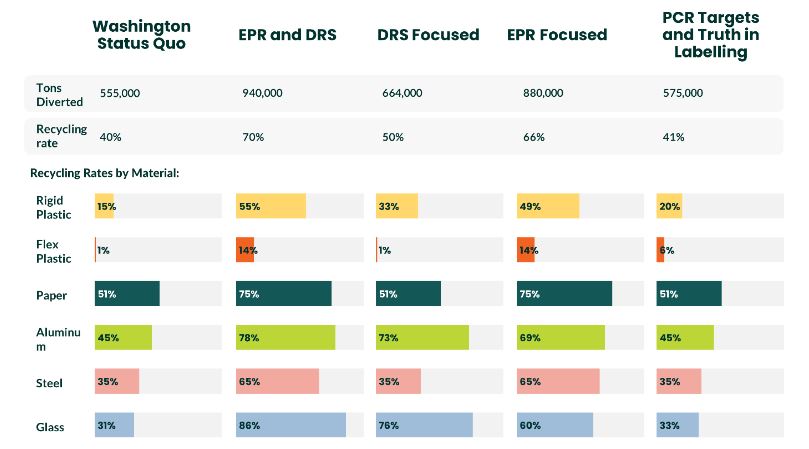
Washington state commissioned Eunomia to conduct several studies to develop a comprehensive recycling baseline for packaging and to develop recycling, reuse and source reduction performance target rates for consumer packaging and paper materials. These studies revealed that a comprehensive policy with both EPR and DRS can achieve the highest recycling rate of 70%. The recently introduced House Bill 2049 mandated producer plans to consider the results of this study and justify any divergence when setting their recycling rate targets.
Colorado set out a slightly different pathway and passed an EPR bill (HB22-1355) that required the PRO conduct a needs assessment before developing the program plan. The PRO, Circular Action Alliance, commissioned Eunomia and HDR to conduct the needs assessment. which involved a comprehensive data collection process including nearly 100 interviews and tours with key service providers and operators, 130 surveys completed by municipalities, and more than 100,000 data points collected. The assessment developed three scenarios which show different options for program implementation taking into consideration collection frequency, program rollout, investment in new infrastructure, and education, among other factors. The study found that EPR can improve recycling rates from between 22% and 28% to between 47% and 60% by 2035 and expand access to recycling for more than 500,000 households who currently do not have curbside service. In April, the state Joint Budget Committee approved the medium scenario, which means the PRO can now move into the implementation phase.
Additional EPR study bills were also passed in Maryland (SB 222) and Illinois (Public Act 103-0383) showing a moving trend towards establishing detailed data for setting policy outcomes before moving to implementation phases.
Fixing the Interior: Data for Implementation
After policy outcomes are set, even more in-depth data can facilitate effective program implementation. States that have already passed EPR are swiftly transitioning into program implementation phases. Circular Action Alliance, the designated PRO, recently submitted its draft program plan application in Oregon as part of their requirements set out in Senate Bill 582, and it has until September to update this plan with more detail on the cost of meeting the requirements of the legislation and how it will prioritize and phase funding to municipalities and service providers. CAA is also in the process of developing the program plan in Colorado, which is due early 2025.
Program implementation will require detailed data to set out reimbursement rates for municipalities and their service providers, put in place contracts, establish producer fees, determine locations for collection sites and finalize a uniform list of collected materials across states. All this information will require further data collection and analysis as much of the requisite information is currently lacking in states.
Maintenance: Data for Compliance and Continuous Improvement
Once policy implementation begins, there will be regular data reporting. This includes data from producers on what packaging they place on the market, data from municipalities on what covered material is collected and recycled and data from the PRO to report progress against targets set in the program plan. All of this together will allow implementing groups to make continuous improvement on the system.
Available Data can Support Policy Development
The development of packaging policy in the U.S. reveals varying levels of data specificity required for the stages of policy development and implementation. As more states pass and implement EPR, data will continue to show the impact of good policy and illustrate realistic policy outcomes.
Advocates and policymakers should take advantage of this increased data availability to drive impactful policy forward. Many of these studies reached similar conclusions, showing that all states can improve their recycling performance through EPR and DRS and the estimated performance under these policies are similar. Although there are benefits to localizing any research reflecting unique opportunities and challenges, this foundational set of knowledge can help kickstart legislative action and create effective and impactful policy.
Michael Wasserman is a senior consultant at Eunomia Research & Consulting. He works with both public and private sector clients to provide strategic and data-driven support to enable a transition towards a circular economy. Wasserman’s project portfolio includes project topics such as conducting EPR needs assessments, evaluating access in recycling programs and understanding best practices for plastic waste management in low- and middle-income countries. He holds a master’s degree in globalization, business and development from the University of Sussex and a bachelor’s in economics and human services from The George Washington University. Contact Eunomia at [email protected].
The views and opinions expressed are those of the author and do not imply endorsement by Resource Recycling, Inc. If you have a subject you wish to cover in an op-ed, please send a short proposal to [email protected] for consideration.