










This article originally appeared in the November 2019 issue of Resource Recycling. Subscribe today for access to all print content.
One of the major talking points across the recycling landscape over the past year has been brand owner goals.
Some of the largest users and producers of packaging on the planet have responded to waste and pollution concerns by setting targets to use more recycled content or use more recoverable packaging.
And one company at the center of the action has been PepsiCo. In the fall of 2018, the food and beverage behemoth committed to hitting 25% recycled content across its portfolio of plastic packaging by 2025. It also said it would achieve 33% recycled plastic in its PET containers.
Those initiatives complement a separate goal by PepsiCo to make all its packaging recyclable, compostable or biodegradable by 2025. And in September of this year, the brand owner announced its goal of reducing its use of virgin plastic in bottles by 35% by 2025.
To understand exactly what those targets entail (and how the company plans to move toward them), Resource Recycling recently talked with Roberta Barbieri, PepsiCo’s vice president of global sustainability.
The interview transcript that follows has been edited for space and clarity.
Resource Recycling: What has dialogue been like inside PepsiCo been amid all the changes of late in recycling markets and plastic pollution concerns?

Barbieri: The last two years have been amazing in terms of the plastic waste crisis coming into the mainstream public consciousness, which as a sustainability professional, I’m pleased to see. It’s really come to the fore in PepsiCo in terms our top priorities for us as a business. We have a pretty robust strategy to address these issues. We talk about it in terms of three pillars, which overall is framed around our mantra that we want to build a world where plastic need never become waste. We’re approaching that aspiration through these three pillars: reduce, recycle and reinvent. So that’s reducing the amount of plastics we use, boosting recycling rates and reinventing our packaging.
Tell me more about that “reinvent” segment. What does reinvented packaging look like?
This is all about getting beyond the single-use bottle. A couple examples of this are our acquisition of SodaStream. You might be surprised to learn that it’s the world’s largest sparkling water brand by volume, and there’s no single-use plastics to be found. Another example is us basically inventing new packaging material that is bio-based – made from plants, not fossil fuel petroleum – and currently compostable in an industrial composting facility but ultimately fully biodegradable in any end-of-life scenario. That material is seen as a replacement for our flexible film bags. Right now we have a couple of places around the world where we’ve introduced industrially compostable flexible film bags. They’re made entirely from plants so their carbon footprint is much lower than the equivalent in a fossil fuel plastic-based material. And they will biodegrade under the right circumstances of heat and moisture, which you generally find in an industrial composter. But recognizing that not a lot of people have access to an industrial composter, we are working on the next generation of that same material which hopefully will be ready for commercialization in a couple years. That material would be biodegradable anywhere. If it ends up in waterways, it will decompose into water and CO2.
Let’s move to the recycling realm. You’ve set a 25% recycled content goal by 2025 across your plastic portfolio. But one thing I’m hearing is that the recycling system is simply not robust enough to deliver that level of food-contact plastic to your company and others.
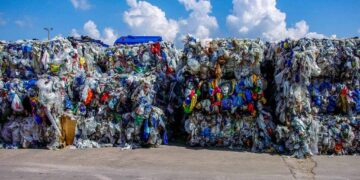
That is indeed a problem. We recognize it as such. The way I talk about the challenges is there are pinch places at several places along the value chain for this material – the collection infrastructure is one of those pinch points.The severity of the pinch points varies country to country and market to market. I heard a statistic that only about 50% of the U.S. has access to convenient recycling at home. We think of the United States as having great access to recycling – it’s not the case. We need more curbside recycling, we need more on-the-go recycling. And once you’ve collected it, you need the infrastructure to process it. The MRFs that do that processing are scattered about and tend to be in high population areas, which makes sense for the business model but contributes to that lack of availability of infrastructure in more rural areas.
How should the industry try to address those pinch points?
One of the things we’ve done to support the development of infrastructure is the funding. Last summer we gave The Recycling Partnership $10 million and wrapped it in this program we call All In On Recycling. It was a call to action for our peers and competitors to match our contribution. The goal was to take our $10 million and grow it to $25 million. And then through the three-to-one matching grant program that The Recycling Partnership runs, they could turn it into a total $100 million investment in U.S. recycling infrastructure. That’s gone very well.
So you are seeing others jump in make contributions?
We are, and that’s on top of existing contributions by many of our peers. So that’s a positive sign.
PepsiCo of course is a global brand, so to move toward these recycled content targets, I imagine you will need to see materials recovery infrastructure improvements across the planet.
Upwards of 80% of the material that makes it into the world’s oceans does so from China, India and Southeast Asia. The reason for that is there’s a lack of waste management infrastructure in that part of the world. So the solution there is you have to start with stopping the flow. Things we think of as basics here, like garbage pickup and waste management, we have to build at scale and at pace in those countries. So it’s pretty daunting. The price tag I’ve heard bandied about for what it would take is in the trillions of dollars, or multi-hundreds of billions. It is a daunting problem. The good news I think is everybody pretty much agrees on the solutions. We need to work on alternative materials and new materials. The regulatory environment has to be an enabler for all this. There’s different levers that are being pulled and that will continue to be pulled. There’s some debate on how hard to lean on this versus that or who should pay for this versus that, but the suite of solutions pretty much everybody agrees on. I find that very heartening. There’s violent agreement that this is a problem we need to fix.
What do you mean by the regulatory environment and it needing to be an enabler?
In several countries in Asia, the biggest barrier to us achieving our 25% recycled content goal is that recycled PET is prohibited by law into coming into contact with food. We cannot put it in our bottles because of local regulations. There is good historic reason to do that – food safety concerns and whatnot. But it’s a huge barrier for us. Even if we could find the material, we legally couldn’t do anything with it. There must be a better way than an outright ban on RPET in food contact. The RPET we use is indeed food grade and poses no safety concerns. Our Naked Juice brand is made from 100% RPET bottles and our premium water brand, LIFEWTR, will be made from 100% RPET bottles in the U.S. beginning in 2020.
When you look at the long-term health of the PepsiCo product portfolio, what seems more important – solving marine debris or strengthening recycling and using more recycled content?
It really is market dependent. For all of our brands, it’s a suite of solutions – eliminating unnecessary plastic as well as increasing recycled content and/or shifting to non-plastic alternatives. You may have seen our announcement about Aquafina water. We’re going to move some Aquafina into aluminum cans while at the same time our LIFEWTR will stay in PET but it will convert to 100% recycled PET. Really, it’s more market dependent than brand dependent.
What is the primary factor behind that decision to shift Aquafina to aluminum in some markets?
There’s a growing request request from customers to move water out of plastic. We have a number of customers through our foodservice organization, which is the part of our company that supplies beverages and snacks to, say, companies that run cafeterias in hospitals or universities or companies. Those customers are getting requests from their customers where they are saying, “We do not want bottled water in plastic bottles.” The aluminum can option is an offering we’ve developed that will alleviate that kind of pinch point in our ability to provide customers with what they need.
What about the plastics recycling technologies that fall under the chemical recycling moniker? Pepsi last year signed a deal with depolymerization company Loop. What role do you see that sector playing when it comes to getting post-consumer plastic back in the pipeline?
Scale-wise, it’s very small but has huge potential. The really intriguing thing about chemical recycling companies is that they can take the lowest quality material and turn it back into virgin-like material. So the material that is ending up in landfills or is downgraded to the lowest downcycled reuse can now be upcycled and become truly circular. We made a volume commitment to Loop Industries. They seem to be further along in their development than a lot of the other chemical recyclers who are very much in startup mode. We also joined with another startup called Carbios. The good news it has tremendous potential. The bad news is they are all small and in startup mode. I think it will be years before that sector scales.
Let’s end by talking about pricing. If virgin plastic continues to trade at low levels, will it be hard for you to maintain your stated commitment to recycled resin?
The resin market is volatile and pricing differs market by market. We have a sourcing strategy in place to manage the volatility, but at the end of the day, the key that everyone needs is availability of feedstock, which means increased collection and recycling rates for plastic.
Dan Leif is the managing editor of Resource Recycling and can be contacted at [email protected].