







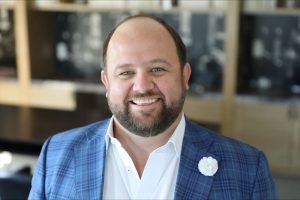
In July, Jonathan Quinn was named CEO of the U.S. Plastics Pact, succeeding Executive Director Emily Tipaldo.
One of the first milestones of his tenure is the recently updated PCR Toolkit, which offers guidance on reducing plastic waste, cutting carbon emissions and meeting rising demands for sustainability from both consumers and regulators.
The Pact is one of a handful of similar initiatives around the world, convened in 2020 in association with the Ellen MacArthur Foundation. The organizations provide a way for stakeholders within the plastics packaging sector to work on goals they’ve agreed to under the foundation’s New Plastics Economy program.
From 2020 through 2022, pact members, known as activators, increased their PCR usage from 7% to 9%, and the updated toolkit includes resources to help educate consumers about the importance of recycled content in packaging, according to a press release.
In conjunction with the release of the update, Resource Recycling News spoke with Quinn to discuss where the organization is headed and how to tackle challenges such as public skepticism and disconnects between many stakeholders in sustainability.
This interview has been edited for clarity and brevity.

So of course, you’ve only been in the role since July. What do you think has been the pact’s biggest success, from before your tenure?
What made the pact the attractive destination for me is there’s no other organization that has been able to provide or deliver cross-industry alignment and execution of a strategy around building a plastic circular economy. There’s nobody that’s even come close, and I think it’s being able to execute the strategy and create that uniform alignment across the entire value chain. Whether it’s the problematic list or the parameters associated with designing for recyclability, it’s creating that unity across the industry and alignment across that strategy. But it’s the action-driven element of tangibly implementing that strategy, and not just being an organization of words but an organization that’s built on actions.
And what would you like to improve on?
Number one, it’s around growth. In order for us to achieve all the things that we want to, we need to make sure that we have all the voices collectively within the value chain at the table.
If we’re missing anybody, we’re going to miss the achievement. We need more activators. One of the most important things is to make sure that we’re growing and we’re delivering value, and we’re creating progress towards a plastic circular economy, and we’re not just flapping in the wind.
And we need to make sure we’re communicating accurately and correctly, but also that people don’t have misconceptions of the pact. And that is as simple as the “problematic and unnecessary” list is not a “banned” list. It’s meant to showcase that there’s problems with materials, so that’s where the work needs to be done.
What can brand owners do to help combat public distrust in plastics and recycling?
The key to it all is transparency. Consumers, in a lot of sense, don’t trust major brands. There needs to be work done to repair that trust, and that’s done through transparency. One of the main fundamental values associated with the pact is committing to goals but also being transparent and showing how you’re improving and also where they’re seeing hurdles.
As 2025 approaches, there has been a growing trend of “greenhushing” – where companies are muted in reporting their sustainability efforts. But it’s kind of like, which came first, the chicken or the egg – you want more transparency, but then you’re really critical, so we’re going to ease back on the transparency. And nobody wins on that one.
“Greenhushing” has been a topic that we’ve discussed multiple times. But I think that there has to be an understanding that if we continue to run and hide, we’re going to continue to go in the wrong direction. I think that also showcases the value of being a part of the pact, because it’s a unified agreement in regards to these goals and strategies across not just brands, but also recyclers, municipal solid waste, resin producers. If we’re all on the same page, it presents the strong front that’s required.
In my own experience as a journalist, you can see some of this in annual reports, having to dig back to previous years to see the change for this year in, say, virgin resin consumption, because the brand owners avoid saying they’ve backslid.
It makes me reflect back to when I was a little kid, and I say this because I also have little kids, and my dad always said, no matter what, don’t ever lie. Always tell the truth, and if it’s bad, we’ll figure it out. We’ll work through it. But if you lie and you’re not being honest and upfront, yeah, it’s going to create issues and problems.
It’s not a message that I’ve been able to fully deliver yet, but it’s one that I firmly believe, that transparency and clarity and making sure that all statements and claims are being done in the eye of science, and making sure that our legal partners are reviewing to make sure that we’re not making excessive or inaccurate statements. As long as we tie any statement or any commitment or all progress associated with science and factual-based reasoning, then we can’t get sideways.
There seem to be a number of disconnects between various stakeholders in the recycling sphere – between legislators, and plastics producers, and brand owners and the public. Do you see that gap when it comes to, say, bans on plastics, which may address one problem but create another?
So I mean, back to that communication thing. We were responding to some interview-related questions about the impact of the pact, of the problematic and unnecessary list, and somebody was like, “Oh, well, let’s talk about the number of grocery bags we reduced,” but grocery bags are not on our “problematic” list. So you don’t need to be communicating about celebrating the amount of plastic grocery bags that are lost or reduced, because at the end of the day, lots of grocery bags are way more sustainable than the alternatives in every way you look at it. What is being said and how it’s being said matters.
What other areas do you plan to focus on?
A specific category where we don’t have a lot of representation is on the packaging machinery side, whether it’s the side of actually blowing film and making film, or whether it’s on the side of packaging, equipment that makes, forms, fills, seals, all the things. I see that as a big opportunity and will further create that differentiation of the value of the pact by having those people.
But whether it’s waste haulers or MRFs, we need more. We need their perspective and their voice, because it’s vital, and then if you go on the other end of the spectrum, we need more resin producers and the organizations that those resin producers are all part of to be a part of the pact as well. We need to make sure that, from a performance and design standpoint, resins and films are being designed the way that they need to, and that we’re pushing the limits, and that we’re seeing the progress and the collaborative support. And then the other side is that we do need more actual converters, whether that’s on the rigids side, whether it’s bottles or cups, or on the flexible side. We need those voices, and we need the voice of the retailers as well.
What kind of strategy do you have in mind for reaching those areas?
Our focus is definitely going to be on that growth, but it’s building the relationships that we may not already have in those silos, finding new conferences for us to engage with, finding new avenues to create conversation, but also leverage some of our existing activators to help create some of that interest and excitement about them being a part of the pact. We’re going to be developing and delivering a strategy around growth.
What else is ahead for the pact?
One of the big things that we have coming up is building out the roadmap for film and flexible circularity, that’s an extension of the overall roadmap. I think the other big thing on the horizon is our involvement in the reusables sector and how we push that forward. We’ve got some exciting things coming there. And then I think in 2025, what will be key is our work in what I would deem very exciting announcements around advanced, chemical and molecular recycling and really establishing our position and how we can support it.
Moving forward, what would you say are the biggest challenges for the pact?
I mean, it’s going to be making sure that we’re growing in a balanced way, and that we don’t get too heavy to one side. But at the end of the day, I think that’s a good challenge to have.
Moving on to regional engagement, what is the relationship with other pacts?
We definitely work closely with the Canadian pact and we have engagement and connection with all the pacts globally. But we sit in a different lens, to a certain extent, because we are the only plastics pact that is an independent organization. But I would tell you our tie to the Canadian pact is very real, and we’ve been collaborating on our film and flexible workshop, and that’s open to members of both pacts – to really take them through the journey and help them to understand more about the overall flexible packaging and film production world. And we’re certainly going to work with Mexico and lend help wherever we can, but also find ways that they can, in turn, follow the bus. At the end of the day, we’re all in this together.
You just returned from presenting at the Packaging Recycling Summit in California. What sessions did you find most interesting?
Myles Cohen presented a paper on corrugated recycling and kind of gave a dose of reality of what’s really happening – people may think that there’s all this paper being recycled, but it really isn’t, and it’s not at the levels necessarily some may believe it to be. I enjoyed Michael Okoroafor, director of sustainability from McCormick spices, and just his perspective and the journey that they’ve been on, and I think there’s a lot of similarities. He discussed a lot of the value associated with uniting as an industry. That’s nice to hear, because it aligns very closely with the pact.
A version of this story appeared in Plastics Recycling Update on Sept. 25.